
The list of skills a forward-deployed Engineer is expected to have keeps getting longer.
Roadmap.sh's FDE roadmap covers everything from React and PostgreSQL to vector databases, Terraform, evaluation pipelines, stakeholder management and executive reporting. Nobody masters all of it. Most strong FDEs are deep in a few areas, competent across the rest, and very good at learning whatever the next client needs.
So what actually separates a strong FDE from an average one? In this guide, we will break down the responsibilities of the role, what the work looks like day to day, the technical and non-technical skills that matter most, and a simple scorecard you can use for hiring or self-assessment.
If you're new to the role itself, start with our complete guide to forward-deployed engineers.
What are the core responsibilities of a forward-deployed engineer?
Although job advertisements use varied language, the duties essentially consist of six things:
- Spend time with the teams that will use the system, map the process and its workarounds, and identify the key data to understand how the job actually works.
- Decide what success looks like. Transform an ambiguous request into one or two quantifiable goals that the company agrees to.
- Create production code that links to the company's current systems, such as the CRM, ERP, data warehouse, or approval procedure, to build and integrate.
- Make sure the system is secure and visible, and test it against real data and edge cases before anyone depends on it.
- Drive adoption by presenting it to users early, adjusting based on their usage, and sticking with it through the first months of production.
- Feed back what you learn. To make the next deployment easier, report persistent issues to the platform or product team.
That last point varies by company. As DataCamp notes in its guide to the role, whether an FDE owns only one deployment or also shapes the wider product is one of the biggest sources of ambiguity in FDE job descriptions. It's worth being clear about which version you mean.
What does a day in the life of an FDE look like?
It changes a lot depending on where the project is. Roughly, there are three phases.
In the first week, a significant portion of the day is dedicated to being with those performing the tasks. An FDE could join an operations team at the beginning of their day, observing what comes in and how it's processed. They pose inquiries that a specification never addresses. What happens when this field is blank? Who decides when two records are the same customer? What goes wrong at month-end? By Friday, they should be able to describe the team's job better than the original brief did.
A few weeks in, the balance shifts towards building. Mornings are devoted to writing extraction logic, building integrations, and testing against live data or a safe copy. Afternoons are spent sharing the unfinished version with users and observing how they respond. This is where most of the real design gets done, because users spot problems no requirements document would have caught.
After launch, the day starts with monitoring. Did last night's run complete? What got flagged for human review? Then there are enhancements: a supplier's new file format, an overly cautious threshold, or a request to expand the system to a different team. It is still being fixed by the FDE who constructed it.
Technical skills every forward-deployed engineer needs
The technical standards for an FDE match those of a highly skilled senior software Engineer. The distinction lies in the scope and in the capacity to function within a space created by another.
Production engineering across the stack
FDEs write code that has to run reliably, often for years. That usually means backend work in Python, TypeScript or Java, enough frontend skill to build a usable interface, and solid habits around testing, version control and code review. A prototype that impresses in a demo but can't be maintained isn't the job.
Integration, data and APIs
The majority of an FDE's tasks involve linking items together. Innovative software, particularly AI, generates value only when it's integrated into the existing systems the business relies on. That takes comfort with APIs, authentication, databases and messy legacy systems.
Data skills sit right next to this. Roadmap.sh points out that a large share of FDE work starts with a data audit, and if you can't untangle a customer's schema, you can't build on top of it. Three versions of the same table, duplicates, and missing fields are common. A competent FDE anticipates them.
Cloud and deployment
FDEs work within the customer’s environment rather than their own. They should have practical knowledge of at least one major cloud platform, containerization, infrastructure as code, and observability. They also need to work within strict security rules, limited access and compliance requirements, which are common in enterprise settings and can slow down anyone who isn't used to them.
Building with and evaluating AI
In 2026, many FDE projects involve AI. That means knowing how to build with large language models, set up retrieval, design agent workflows and choose between model providers. More significantly, it entails demonstrating the system's functionality through monitoring, guardrails, and assessment sets before people depend on it.
The evaluation aspect is the most important. An FDE must determine when AI-generated code or AI output is sufficient for release, and when it falls short. We explored why that skill is becoming the real differentiator: AI doesn't replace Engineers; it reveals which ones are elite.
Non-technical skills that matter just as much
Plenty of Engineers have the technical skills above. Far fewer have these.
Discovery and problem framing
The request an FDE receives is rarely the real problem. A former Palantir FDE, writing in The Definitive Guide to Forward Deployed Engineering, describes noticing an analyst who spent 45 minutes every morning manually combining data from three systems. She had never sought assistance, believing it was simply part of the role. A good FDE builds what is requested; a great one identifies the problem no one thought to raise.
Communicating with different audiences
An FDE might explain the same delay to a CFO in the morning and to a senior Engineer in the afternoon, using completely different language. The CFO needs the business risk in two sentences. The Engineer needs the technical detail. Being able to switch between the two, without talking down to either, is one of the clearest signs of a strong FDE.
Product and business sense
FDEs constantly decide what to build specifically for one client and what should become reusable. According to DataCamp, doing this incorrectly results in a mountain of one-off code that no one can maintain, which is a true failure mode of the position. To ensure that the activity is targeted at the appropriate number, good product sense also entails knowing which outcome the company genuinely cares about.
Owning outcomes without formal authority
FDEs frequently require assistance from individuals they do not supervise: an IT team from the client, a security analyst, a product group within their organisation. The same Substack guide calls this the hardest FDE skill. Asking politely rarely works. Explaining the business impact, with numbers and a clear request, usually does.
What separates a strong FDE from a good traditional Engineer?
Coding ability isn't usually the gap. These are.
- They calibrate how much to build. Sometimes the right answer is a solid, configurable system. Sometimes it's a single query that runs once. Strong FDEs can tell the difference, and they're honest when they've overbuilt.
- They push back on the right things. A three-month special feature is requested by a customer. After spending a day or two figuring out why, a competent FDE frequently finds a more straightforward solution to address the actual need. Accepting everything does not equate to ownership.
- They stay calm when production breaks. And it will break, sometimes during a board demo. How an FDE handles that moment shapes the client's trust as much as the fix itself.
- They think beyond the ticket. A traditional Engineer is often judged on what they shipped. An FDE is judged on whether it's being used and whether it moved the number the business cared about.
None of this is unique to FDEs. It's what good senior Engineers have always done. It's also close to what we look for more widely, as set out in our 10-point checklist for what makes an Engineer elite. The FDE role simply makes these skills the core of the job rather than a bonus.
The FDE skills scorecard
Use this to assess a candidate, a team member or yourself. Score each skill from 1 to 3:
1 = Developing: needs support or close supervision in this area.
2 = Solid: handles it well in familiar situations.
3 = Strong: handles it well in unfamiliar or high-pressure situations, and helps others.
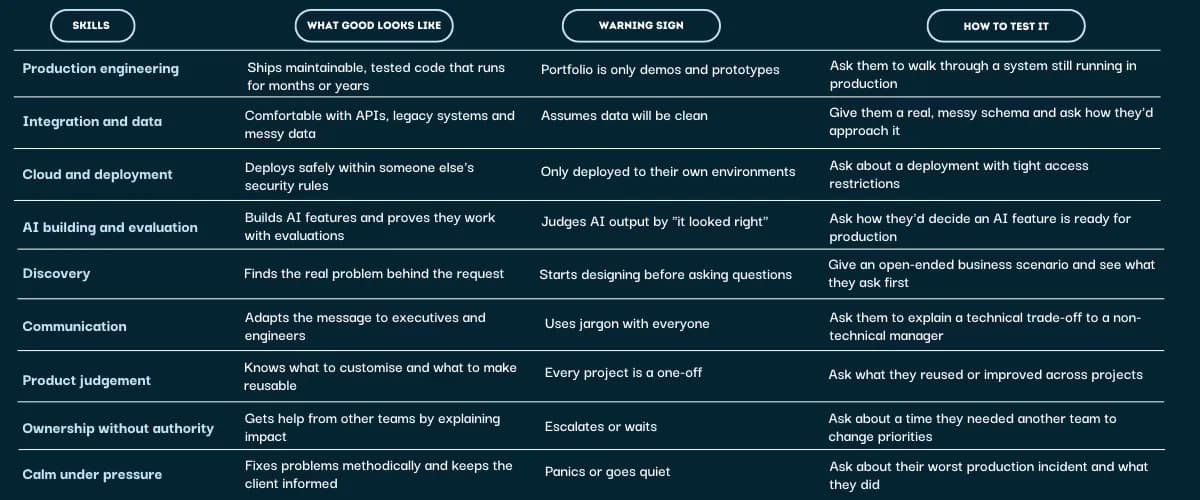 How to read the scores: for an FDE role, look for at least a 2 everywhere and a 3 in production engineering plus two or three of the non-technical skills. A candidate with straight 3s in technical skills and 1s in everything else is a strong Engineer, but probably not an FDE yet.
For engineers using this as a self-assessment, the lowest scores show where to focus next. For CTOs, our guide on how to hire forward deployed engineers turns the scorecard into interview questions.
How we hire for these skills
The profile in this guide is close to what we look for in every Engineer we bring into a client team. Strong technical foundations come first, then the judgement and communication that let someone question a requirement instead of quietly building the wrong thing.
Our Engineers work inside our clients' teams, in their tools and meetings, and talk directly to the people who'll use what they build. Through our co-sourcing model, that works for a long-term product team or for a specific problem that needs this kind of ownership, such as getting an AI project into production. If you're trying to build this capability, talk to us.