AI Doesn't Replace Engineers. It Reveals Which Ones Are Elite

- Tech
- Business

Two Engineers get handed the same AI coding assistant, the same repo, the same ticket. Three hours later, one has shipped a clean, tested fix. The other has shipped something that looks clean and quietly breaks an edge case nobody checked for. Same tool. Roughly the same prompt. Completely different outcome.
That gap is the real AI story in engineering this year. Not replacement. Sorting.
Nobody's roadmap gets built by handing a laptop to a chatbot and walking away. In reality, what's happening on engineering teams in 2026 is more subtle than the headlines and far easier to comprehend: AI is revealing an engineer's already excellent judgement more quickly and clearly than any performance assessment has ever been able to. The data supports this in a way that should alter hiring practices, team structures, and the people you first trust with an AI license.
Why "Will AI Replace My Engineers" is the wrong question
Search "does AI replace software engineers" on Google, and you'll land in the same circular argument every time. One camp says AI writes code well enough to make most developers redundant. The other says engineering was never really about typing syntax and never will be. Both sides are arguing about the wrong variable.
Whether AI can produce code isn't in question. It obviously can, for a huge share of engineering teams already. What matters is what happens next. Who reviews that code critically. Who catches the edge case AI missed. Who knows the one architectural reason a correct-looking suggestion is still the wrong call. That part hasn't changed. It was always doing the heavy lifting, and it's the part no model has touched.
This picks up where we left off on what "elite" means for an engineering team in the AI era, and goes further into the mechanism: not just that AI amplifies strong Engineers, but exactly how it exposes the weak spots a bigger headcount used to paper over.
What the data actually shows: AI widens the gap; it doesn't close it
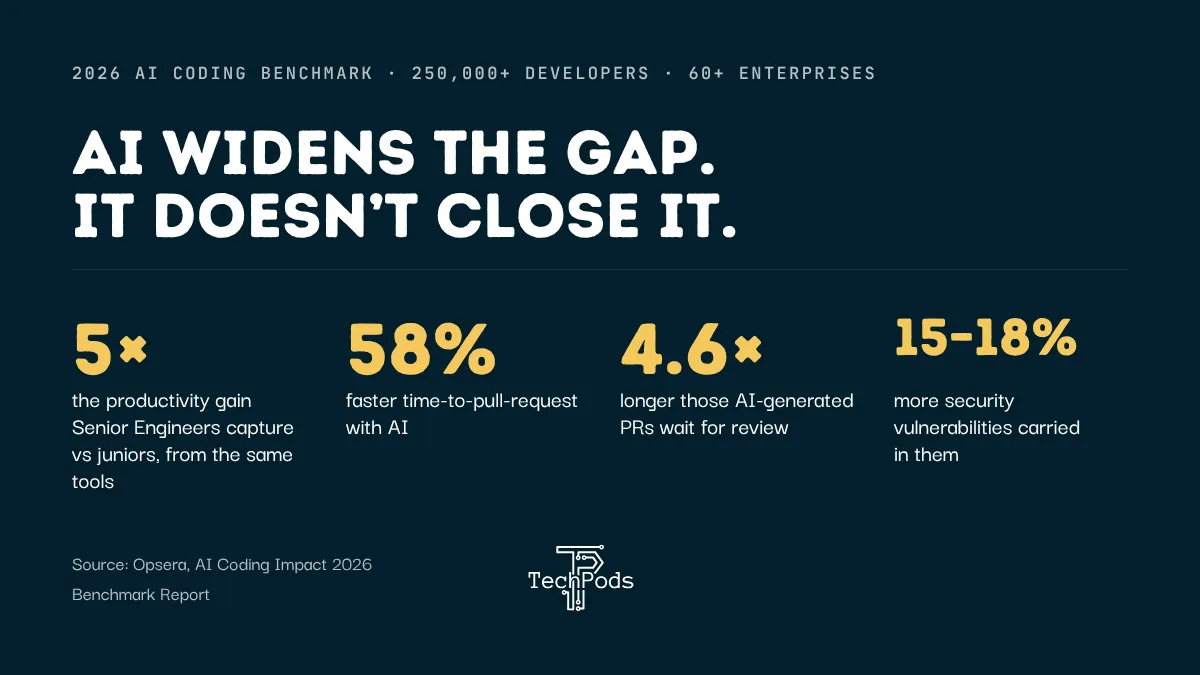
If AI made every Engineer better by roughly the same amount, the skills gap on engineering teams would be shrinking. It isn't. It's widening, and 2026's research is oddly specific about it.
A 2026 AI coding benchmark covering more than 250,000 developers across 60-plus enterprise organisations, spanning tools like GitHub Copilot, Cursor and Claude Code, found that senior Engineers capture nearly five times the productivity gains of junior Engineers from the same tools. AI cuts time-to-pull-request by up to 58%. Fair enough, that sounds like a win. But those same AI-generated pull requests then wait 4.6 times longer for review than human-written ones, and carry 15 to 18% more security vulnerabilities. Adoption is nearly universal too: 90% of teams use AI daily. Yet 21% of AI coding licences sit largely unused. Access was never the bottleneck.
Put plainly: AI isn't turning average Engineers into senior ones. It's giving average Engineers a faster way to produce more code that a senior Engineer, or nobody, still has to catch.
The most-cited pushback on "AI just makes everyone faster" comes from an unlikely place. A research group called METR ran a controlled trial in 2025 and found something nobody expected. Even though they thought they were 20% faster on average, seasoned open-source engineers utilising AI technologies spent 19% longer to complete tasks than developers working without it. The significant discovery was not the slowness per such, but rather the discrepancy between what these engineers perceived and what actually occurred.
Here's the more interesting part, though, and it's the bit most people skip. When METR revisited the experiment through August 2025 into early 2026, they found their original result had been skewed by who chose to take part. Developers who expected the biggest gains from AI increasingly refused to do tasks without it. Between 30 and 50% of participants started dodging the tasks they believed AI would speed up most, rather than let the study measure them honestly. Once you account for that, METR's own researchers now think AI is likely delivering real speedups in 2026. Measuring it cleanly just got harder, not easier, because behaviour, not the tool, is what's actually driving the outcome.

Which is really the whole argument of this piece in one data point. The tool didn't change nearly as much between 2025 and 2026 as how people chose to use it, trust it, and quietly route around anyone trying to measure it.
The real divide isn't "uses AI" vs "doesn't." It's judgement vs speed
With AI adoption sitting around 90% of engineering teams, "does your team use AI" stopped being a useful question sometime in 2025. Nearly everyone does. The variable that still separates teams isn't access. It's what happens between the AI's suggestion and the code that actually ships.
Kelsey Hightower, the Google Distinguished Engineer, put a version of this into words publicly in 2026: AI is replacing the Engineers whose only worth was being able to code, not the ones with broader judgment and a larger set of abilities to draw on. That lines up exactly with what the benchmark data shows. An Engineer who can only produce syntax faster is now competing with a tool that produces syntax instantly, and losing. An Engineer who can explain why that syntax is the wrong choice for this system, this load, this particular edge case, has become harder to replace than at any point in the last decade. That judgement is precisely what AI still can't manufacture.
This is also where many engineering leaders get the risk backwards. The danger in 2026 usually isn't a bad Engineer using AI badly. It's a manager mistaking the speed of AI-assisted output for competence and rewarding the appearance of velocity over its substance. A pull request that arrives fast isn't automatically one worth merging.
What Elite Engineers Actually Do Differently With AI
Strip away the statistics and a consistent pattern shows up in how strong Engineers actually use these tools day to day. It doesn't much matter which one.
They view AI output as an initial draft rather than a final solution. Every recommendation is reviewed, tested, and, more frequently than junior engineers anticipate, either completely rejected or rewritten.
They know when not to touch it at all. Ambiguous requirements, architectural trade-offs, anything with real blast radius: a human works through those first. AI comes in once the direction is set, not before.
They can explain every line that ships, whoever wrote it. "The AI generated it" has never been an acceptable answer for a bug in production. Elite Engineers treat it that way by default, no policy required.
Instead of using AI to speed up their thinking, they utilise it to expand their alternatives. Accepting the first response that seems feasible is not the same as coming up with three strategies and selecting the best one.
They get faster with AI over time, not slower. This is the practical tell behind the METR finding. Engineers whose judgement compounds get genuine speedups from AI. Engineers who lean on it to skip the judgement step tend to plateau, or quietly create more rework than they save.
None of this is a personality trait. It's a set of habits, which means it's coachable. It's also exactly what a hiring process or a team audit should be checking for in 2026, rather than "have you used Copilot?"
What This Means for CTOs Sizing Teams in 2026
If AI genuinely widened the gap between strong and weak Engineers by 5x on productivity alone, a headcount plan built around average output per Engineer is measuring the wrong thing. We've covered the mechanics of that separately, in how to size a team around capacity vs capability rather than headcount, and there's a sharper "10 developers or 3 elite Engineers" version of the same trade-off coming shortly in this series. What this article adds is the reason those frameworks matter more in 2026 than they did two years ago. Now, guessing wrong about capability costs more, faster, because AI puts more code in front of reviewers before anyone spots the judgement gap underneath it.
It also means "just give the team an AI licence" isn't a strategy. When an exceptional team and an average team are given the same tool, the gap between them doesn't shrink. It opens up even more because, for better or worse, the technology magnifies any discipline, review habits, and ownership that were already present. A team with weak code review gets faster at shipping weak code. That's not a fix. It's the same problem, arriving with better packaging.
The Honest Test for Your Team
There's a simple, practical way to check which side of this your own team sits on, and it doesn't need a formal audit. Look at what's happened to your review cycle and your rework rate since AI adoption went up. Not your output volume.
If pull requests are getting reviewed faster and rework is flat or falling, your team's judgement is compounding the way it should. If output has climbed but review time, bug rates or "wait, why did we ship this" conversations have climbed with it, AI isn't making your team more capable. It's making an existing capability gap ship faster.
That second scenario deserves real attention, because it's easy to mistake for progress right up until it isn't. AI won't fix a team that was already leaning on hands rather than judgement to get by. It just hides that for a little longer.
The Talent Question This Actually Raises
None of this is an argument against AI tooling. It's an argument for being honest about what it's revealing rather than what it promises. The Engineers worth building a 2026 roadmap around aren't the ones who adopted AI first. They're the ones whose judgement was already strong enough that AI became a genuine multiplier, rather than a faster way to produce the same mistakes.
That's what Elite Systems. Elite Teams. means in practice at TechPods. We don't vet the Bulgarian engineers we build dedicated pods around on how quickly they can prompt an AI tool. We vet them on the judgement that decides whether AI output ships as an asset, or gets quietly rewritten by someone more senior three weeks later. If you're trying to work out which side of that gap your own team, or the one you're about to hire, actually falls on, that's the conversation worth having before the next headcount decision goes to the board. Talk to TechPods about finding Engineers whose judgement AI genuinely multiplies.
Frequently asked questions
Does AI replace software engineers?
No, not in the way most headlines suggest. AI replaces the narrow task of writing syntax, which was never the hardest or most valuable part of the job. It doesn't replace the judgement needed to decide what to build, catch what AI gets subtly wrong, or take ownership of the result, which is why demand for genuinely skilled Engineers hasn't dropped even as AI adoption has become nearly universal.
Will AI replace junior developers?
AI is replacing the narrowest version of the junior developer role, someone whose main value was producing code quickly from a clear spec. It's not replacing junior Engineers who are building judgement, asking good questions and learning to review critically, though it is raising the bar for what "junior" needs to mean in practice.
How is AI affecting the skills gap between engineers?
It's widening it. Research from a 2026 benchmark of over 250,000 developers found senior Engineers capture close to five times the productivity gains junior Engineers get from the same AI tools, largely because senior Engineers know when to trust AI output and when to override it.
Related posts

- Tech
A CTO's take on AI

- Business
- Tech
Why adding more Engineers doesn't always mean faster delivery


- Business
Capacity vs Capability: a new framework for sizing engineering teams

- Business
- Tech
How many developers do you actually need? A CTO's decision framework

- Business
- Tech
10 developers or 3 elite engineers? How CTOs are deciding in 2026

- Business
- Co-sourcing
Elite systems. Elite teams. Why we're changing what "scaling" means