Elite systems. Elite teams. Why we're changing what "scaling" means

- Business
- Co-sourcing
- Company Updates

Eight years ago, if you asked a CTO what kept them up at night, the answer was almost always the same: “I can't hire fast enough, or I need to scale faster- how can I do this?”
Recruitment cycles ran long, often past three months for a single senior hire. Good Engineers had three offers on the table before you'd finished the second interview. Every unfilled seat was a launch that moved, a sprint that slipped, a roadmap quietly rewritten around who was available in the market, not who the current project actually needed.
That's the world TechPods was built for. We looked at the traditional outsourcing model. We saw what was not working and the downsides of it. The bench developers, the vendors who swapped your team every few months, the lack of transparency, the hidden costs. All of these established bad practices made us say: “NO, companies had had enough of this”. Engineers shouldn't sit outside your organisation. They should be part of it. Companies should start hiring proper rockstar Engineers and not paying for juniors sold as seniors for lower cost. Companies needed high quality, speed, transparency and dedicated engineering teams who are hired exclusively. That belief became Co-Sourcing NOT Outsourcing, and for eight years it's held up remarkably well. It still does, actually. What's changed is the question underneath it.
The market stopped asking "How Many?"
Something shifted in the last eighteen months, and most engineering leaders felt it before anyone put a name to it. Yes, it’s AI. AI evolved, and with the possibilities it brought, the changes and businesses needed to find a way to adapt. However, the question is always the same: how did the whole evolution happen so fast, and what were the changes?
AI didn't just speed up how code gets written. The truth is that it changed the maths of what one good Engineer can produce in a day. A project or a task that needed a team of three or four in the past can now be replaced by a senior developer who uses the right tools, the right judgement, and a codebase that actually understands. Boards noticed. Finance teams noticed even faster, because headcount has always been the line item everyone understands, even the people who don't understand engineering.
So the conversation changed. It's no longer how quickly can we add ten more Engineers to the team. It's how much can we get out of the two or three we already trust. Headcount used to be the scoreboard. Now it's starting to look like a cost line that needs justifying, not a badge of progress.
We think that's the right question to be asking. And it's one we're better placed to answer than most, because we've spent eight years learning what makes an Engineer worth building a team around in the first place.
From “Co-Sourcing not Outsourcing” to “Elite Systems. Elite Teams”
Here's the honest version of where we're heading.
The problem our co-sourcing was focused on was clear: “How do you scale tech teams without the risk, the opacity, and the churn of traditional outsourcing?” Some of the principles used in our philosophy were transparency, integration and long-term thinking. These few things got us here after 8 years and 92%+ retention across our teams. Thus, we can conclude that this model worked; it helped our partners and the needs they had. We learned a lot during these past years, but what stood out is that Engineers who feel like stakeholders don't leave after six months. From the client side, partners who get full visibility over their teams don't get nervous halfway through a project.
But capacity was never really the point. Capability was. Capacity is simply the easiest way to measure capability when you don't have a better tool for it, and for a long time, nobody did. AI changed that. Capability, in a world where a single senior Engineer can wield genuinely serious leverage, doesn't scale the way it used to. Adding more people to a problem doesn't automatically add more output. Sometimes it makes the problem bigger.
That's why TechPods is evolving into Elite Systems. Elite Teams.
Not a new company or a new philosophy. Not a rebrand for the sake of a new logo or a tidier deck, either. A sharper answer to a question our partners are already asking us in every discovery call: do we actually need ten developers, or do we need three who can do the whole job?
Co-Sourcing doesn't disappear. It becomes the method, not the headline. The way we build teams, integrated and transparent, that feel like a natural extension of your internal tech team, stays exactly the same. What changes is what we're building towards, and what we're prepared to tell you when the honest answer isn't "more people."
What "Elite" Actually Means for TechPods
One of our core principles is authenticity, and by using elite as a word in our new slogan, it looks like we are shifting away from this principle. For us, an elite Engineer isn't just someone who writes clean code fast. It's someone who:
- Can think in outcomes, not only closed tickets. Such Engineers understand why something is being built, not just how, and they'll push back on a spec if it doesn't hold up.
- Uses AI as leverage, not a shortcut. We know that AI accelerates decisions and writing code, but the judgement behind it is still entirely human. Badly written code with AI delivered faster is not progress.
- Own their results. Success is not measured by how many hours an Engineer logged in the system or how many tickets they closed. It’s about what they actually shipped.
- Communicate like a colleague, not a contractor. Our Engineers will sit in your standups because they're genuinely part of the conversation, not observing it from the sidelines. They feel like a natural extension of your tech team and work on a single client or project at a time. They do not split focus across multiple projects simultaneously, ensuring total alignment with your goals.
- Know why something needs to be built. Restraint is underrated in this industry, and it's one of the clearest signals of real seniority. The best engineers don't just focus on how to build something. They understand why it should be built and where it can create the most value.
That's what elite looks like at the individual level. But an elite team isn't just a collection of elite individuals; it's a set of principles that shapes how they operate together. Here's how we define it:
.webp)
AI doesn't replace elite Engineers. It amplifies them.
This is where a lot of companies get the whole story wrong.
AI doesn't make Engineers less necessary. Actually, it shortlists the most adaptive ones and makes the difference between an average Engineer and an elite one much more distinctive. The difference is simple. The average developer who uses an AI assistant can be faster, can produce more code, but will fix more bugs later. On the other hand, an elite Engineer with the same tool will make better architectural decisions, spot the AI's blind spots before they ship, and orchestrate considerably more engineering work than they could alone.
Simply put, AI is making engineering cheaper, and most of us can agree on this, but what makes AI valuable is the elite engineering. The current AI tools and assistants are genuinely useful, but they don't substitute judgement, product understanding, or the ability to know when the AI's confident-sounding answer is quietly wrong. That's still a human skill, and it's the one we've always screened hardest for.
Capacity vs Capability
It might help to see the shift laid out plainly, because it's easy to lose the thread when the underlying assumptions haven't been named.
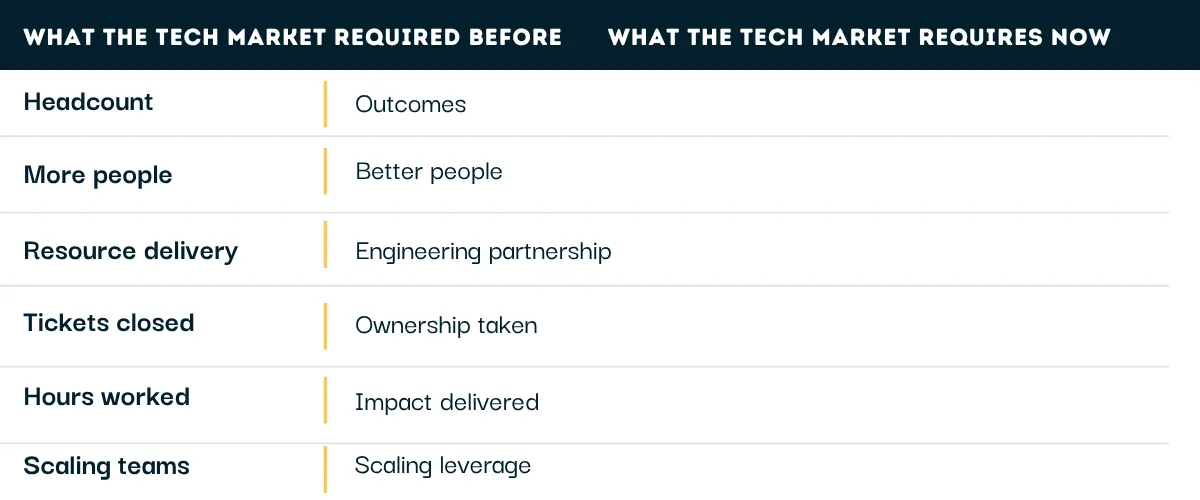
None of this means TechPods is becoming a different company, or that anything about how we work is changing. It's the same team, the same principles, the same service - just better.
This isn't TechPods pivoting to "co-sourcing was bad, elite is good." The reality is that our model was optimised for capacity, because capacity was the constraint that mattered most. Now we need to optimise for capability, because capability is where the value sits these days, and AI is what moved it there.
We're responding to what our clients are actually asking for, which happens to be a more interesting conversation than the one we were having five years ago.
What this looks like in practice
If you're a CTO or VP of Engineering and your goal is to weigh up the costs and benefits of adding three more hires or restructuring around a smaller, sharper team, here's what a conversation with us can now look like.
- We start with the outcome, not the org chart. What are you actually trying to achieve in the next two quarters? From there, we work backwards to the team required, rather than forwards from a headcount number someone wrote down in a budget meeting six months ago.
- We tell you if you don't need more people. If the honest answer is that two exceptional Engineers with the right AI tooling will outperform six average ones, we'll say so. That's not a sacrifice on our part. It's the only way this positioning means anything.
- We keep the parts that already work. Full pricing transparency. Zero lock-in. Engineers who join your team from day one and start performing, not after a three-week onboarding process nobody enjoys. And the calibre hasn't moved an inch either: these are still the same Engineers who'd stand out in any market, not just ours, the ones we've always called rockstars, and not as a throwaway compliment.
Where we go from here
TechPods spent eight years challenging how companies build engineering teams. We're now challenging what those teams should be expected to deliver.
“Co-Sourcing NOT Outsourcing” got us here.
“Elite Systems. Elite Teams.” is where we're going.
If you're standing at a crossroads, still working out whether your team is elite or already outdated, that's exactly the conversation we're set up to have. We can help you decide whether your next step is 10 developers or 3 elite ones. Get in touch with TechPods; we will be happy to talk it through.
Frequently asked questions
Why is TechPods shifting its positioning from "Co-Sourcing Not Outsourcing" to "Elite Systems. Elite Teams."?
AI has changed the scaling equation over the past 18 months, so instead of asking "how many engineers do we need," TechPods now focuses on how much its best engineers can accomplish with the right tools.
Does AI replace the need for software engineers?
No, AI amplifies the good engineers rather than replacing them, since they use it as a tool to work faster while still applying judgment, product understanding, and architectural thinking to catch flaws that average developers miss.
What is the difference between capacity and capability when scaling an engineering team?
Capacity scaling means adding headcount to increase output proportionally, while capability scaling means a smaller team of elite, AI-augmented Engineers delivers better results than a larger team of average developers.