10 developers or 3 elite engineers? How CTOs are deciding in 2026

- Business
- Tech

At least once this year, CTOs have wondered whether to hire 10 developers or 3. They've also wondered whether 10 developers is enough or too many, and whether they need only 3 elite engineers. Nobody states it quite that starkly in a planning meeting, but this is a real question that is key in making headcount decisions in 2026. This question will intensify because for the first time, both options can genuinely deliver the same roadmap.
We've written before about how many developers you actually need and about the capacity vs capability framework underneath that question. This article takes the sharper, more binary version of both: not "how many people," but what type of people - ten generalists or three specialists - actually get the work done.
Why this became a real decision in 2026, not a thought experiment?
About five years ago, before AI programming became so popular, it was as if the maths favoured volume almost by default. This was because no matter how good a senior developer was, they could only reproduce a certain amount of work in a sprint. This is why "three Engineers instead of ten" wasn't a serious option for most delivery-critical work.
AI coding tools have moved that ceiling. A well-scoped feature that needed three or four people to design, build, test and review two years ago can now often be handled by one senior Engineer with strong judgement and the right tooling around them, a shift we covered in more depth in Elite Systems. Elite Teams.
It is important to note here that the comparison should be done properly with real numbers, not just by instinct. CTOs need to think carefully because most of them are used to the "more hands feels safer" mindset and thus miss a cheaper, faster option. A CTO who defaults to a small elite team because it sounds leaner is ignoring the scenarios where it genuinely isn't the right call. Both mistakes are expensive. Neither is obvious from the org chart alone.
Two shapes of team: the side-by-side comparison
Here's what actually differs between the two shapes of team, beyond the headcount number.
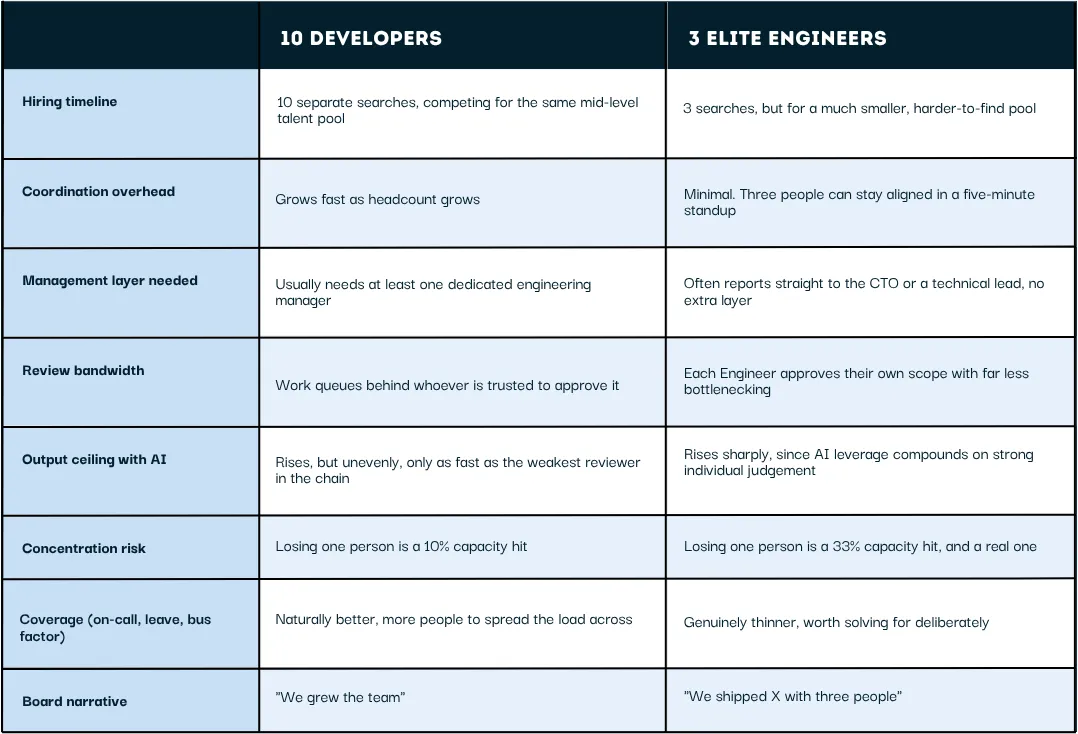
Neither column is the "correct" one. The table exists to make the trade-offs visible before the decision gets made, not to make it for you.
The cost comparison nobody states honestly
The first argument for volume is usually cost: ten people obviously cost more than three. That's true in raw headcount, but it skips the parts of the comparison that never show up as a clean per-person line item.
Ten searches cost more than three, and not just in fees.
Recruiting effort scales with headcount, not with output. Ten separate hiring processes, all competing for the same crowded mid-level talent pool, take longer in total and pull more of a CTO's or hiring manager's time than three harder, more selective searches for genuinely senior people.
The management layer is the real hidden line item.
A team of ten typically needs a dedicated engineering manager or team lead to stay coordinated. Three Elite Engineers rarely need that extra layer at all. That's a full additional role that never appears on the "developer headcount" slide, but shows up in the org chart and the payroll all the same.
Seniority costs more per head, but that's the wrong comparison.
Elite Engineers command a real premium over mid-level hires. The comparison that actually matters isn't cost per head, though. It's cost per shipped outcome, once the onboarding drag a larger team carries (covered in more depth in why adding more Engineers doesn't always mean faster delivery), and the review bottleneck of a bigger team are priced in properly.
Run the comparison this way, rather than by headcount alone, and the total cost gap is usually smaller than the ten-to-three ratio suggests. It often favours the smaller team once the hidden costs are counted, not the obvious one.
What AI actually changes about the equation?
It's tempting to assume AI tooling simply makes everyone faster, which would leave the ten-versus-three comparison roughly where it was. That's not what the evidence shows.
JetBrains' April 2026 analysis for technical leaders, which builds on DORA's 2025 AI Capabilities Model research, confirms the same pattern with newer data: AI does not level teams out, it amplifies what's already there. Teams with strong review habits and clear ownership get measurably more out of adopting it. Teams without those foundations get their existing bottlenecks amplified instead, faster than before, not fixed.
One of the findings behind that conclusion is a direct problem for the ten-person team specifically. Citing LinearB's 2026 Software Engineering Benchmarks, the analysis found that pull requests written with AI assistance already wait 2.5 times longer for review than ordinary ones, and autonomous AI-written code waits 5.3 times longer again. AI doesn't add reviewers. It adds more work for the reviewers a team already has, and that's exactly the queue a ten-person team is more likely to be stuck behind. A team of three Elite Engineers, each capable of reviewing their own and each other's output critically, converts AI leverage into shipped, trustworthy work with far less friction.
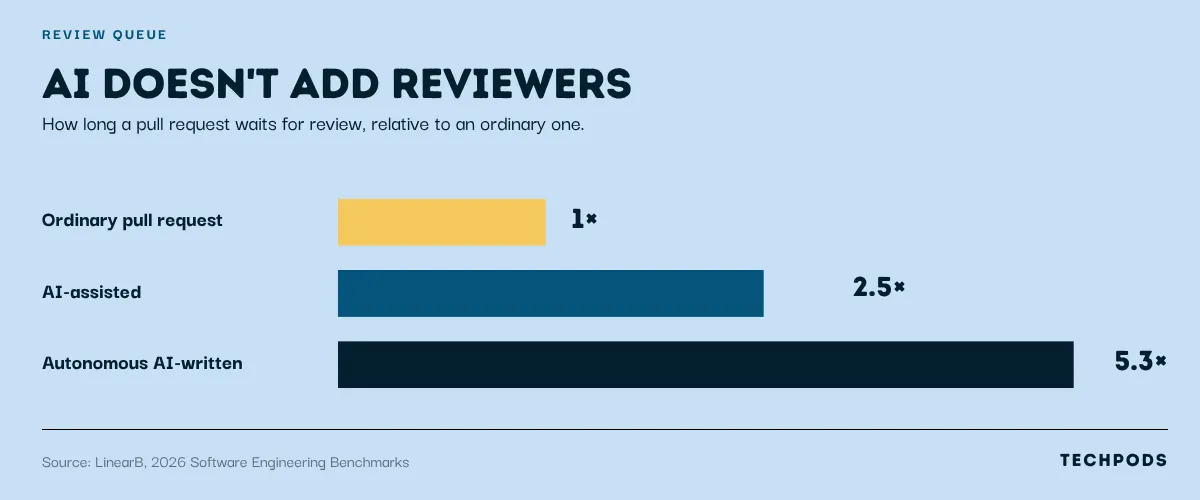
AI doesn't make headcount less important because it makes everyone faster equally. It makes headcount less important because it makes the gap between strong judgement and average judgement bigger than it's ever been.
When ten developers is still the right call?
Nothing written here is an argument that having a smaller team is always better. Ten developers is genuinely the stronger choice when:
- The work is highly parallel and independently scoped.
Ten separate integrations, ten regional storefronts, ten largely self-contained features. Volume helps when nothing is waiting on anything else.
- Output is important, but so is coverage.
On-call rotas, holiday cover and bus-factor risk are real costs, and a three-person team feels this more than a ten-person one.
- You need breadth across many domains at once.
Mobile, backend, data, infrastructure and QA all moving simultaneously often needs more distinct skill sets than three people can hold, however strong.
We go into the fuller list of scenarios, and the maths behind scope parallelism specifically, in our team-sizing decision framework.
When three Elite Engineers win?
The three-Engineer option is the stronger call when:
- The bottleneck is not hands; it is judgement.
If the real constraint is architectural decisions, unclear requirements, or knowing which corners are safe to cut, adding more mid-level Engineers adds more people waiting on the same judgement, not more of it.
- Review capacity is already the ceiling.
If your senior Engineers are already spending half their week reviewing other people's work, ten more developers means more of that, not less.
- Resources genuinely can't stretch to both volume and seniority.
A scaleup choosing between ten mid-level hires and three senior ones usually gets more shipped, more reliably, from the smaller team, once AI leverage is in the mix.
- The work rewards deep ownership over broad coverage.
Complex, high-stakes systems (payments, security, core infrastructure) tend to benefit more from three people who deeply understand the whole system than ten who each understand a slice of it.
The three-question test
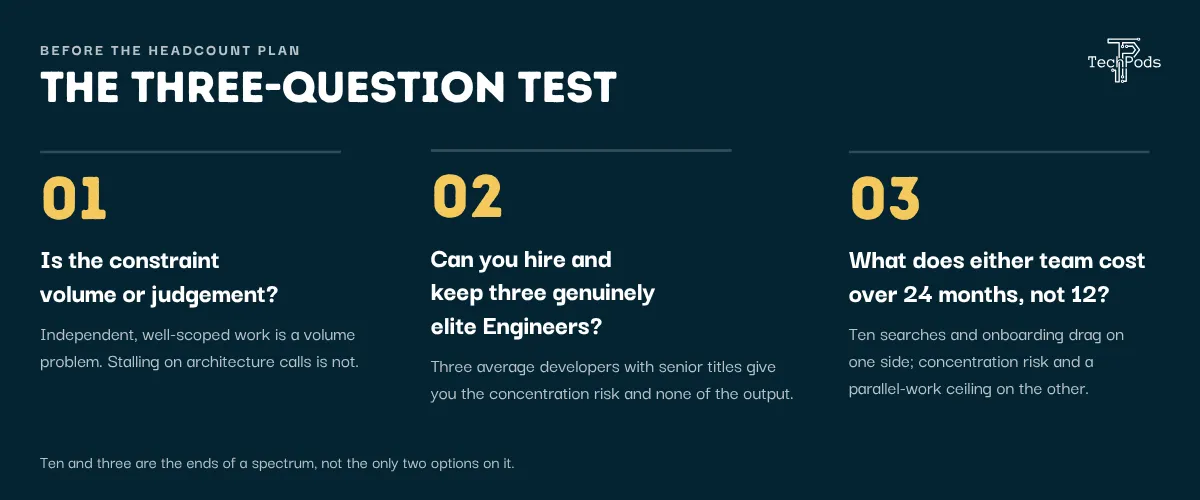
Most sizing conversations start with "how many people can we afford" and work backwards. A more honest starting point is three questions, in this order.
- Is the constraint volume or judgement?
If the backlog is full of well-scoped, independent work and nothing is waiting on a senior decision, that's a volume problem. If work keeps stalling on architecture calls, ambiguous requirements or review capacity, that's a judgement problem, and more people won't solve it.
- Can you actually hire and keep three genuinely elite Engineers?
This is the question CTOs skip most often. "Three elite Engineers" only works if they're actually elite. Three average developers with a senior job title attached gives you all the concentration risk of a small team with none of the output advantage. If your hiring pipeline can't realistically land elite-calibre talent, ten solid developers may be the more reliable bet than three mediocre ones.
- What does either team cost over 24 months, not 12?
A ten-person team's true cost includes the recruiting effort of ten searches, the onboarding drag on whoever mentors them, and the retention risk each person adds. A three-person team's true cost includes the concentration risk of losing one, and the ceiling on parallel work three people simply can't cover. Model both past the first year, not just against this quarter's headcount plan.
Most CTOs land somewhere between ten and three
The honest answer for most engineering organisations isn't a clean choice between the two. It's a small core of Elite Engineers who own the parts of the system that need judgement, supported by additional hands where the work is genuinely parallel and doesn't need that depth. Ten and three are the ends of a spectrum, not the only two options on it.
What's changed in 2026 is that the smaller end of that spectrum now produces a credible, board-defensible amount of output, which it didn't five years ago. It's why TechPods builds dedicated engineering pods around Elite Engineers rather than headcount: people vetted against what "elite" actually means at TechPods, who join your standups, own outcomes rather than tickets, and are chosen for the judgement that makes AI leverage compound rather than accumulate as rework.
If you're weighing a headcount plan against a smaller, senior one right now, that's exactly the conversation we have with CTOs before either plan goes to the board. Talk to TechPods about finding the two or three Elite Engineers who'd actually move your roadmap, instead of the ten who'd just be busy on it.
Frequently asked questions
Is it cheaper to hire 10 mid-level developers or 3 senior engineers?
Often, the three-person team costs less in base salary alone, and the gap widens once management overhead, recruiting effort and onboarding time are included. The exact numbers depend on location and seniority mix, but the direction holds across most UK and European markets.
When does it make more sense to hire more developers instead of fewer, senior ones?
When the work is genuinely parallel and independently scoped; when coverage and redundancy matter as much as output, or when the roadmap needs breadth across many distinct domains at once rather than depth in one system.
How do I know if my team's bottleneck is headcount or capability?
Check whether work is stalling because there aren't enough hands on well-scoped, independent tasks (a headcount problem), or because it keeps waiting on judgment calls, architecture decisions or review capacity from one or two people (a capability problem). More hires only solves the first one.
Related posts

- Business
- Tech
Why adding more Engineers doesn't always mean faster delivery

- Business
- Tech
How many developers do you actually need? A CTO's decision framework

- Business
Capacity vs Capability: a new framework for sizing engineering teams

- Business
- Co-sourcing
Elite systems. Elite teams. Why we're changing what "scaling" means