Forward-Deployed Engineer vs Solutions Engineer vs Solutions Architect vs Consultant
- Business
- Tech

If you start reading job postings that contain the word “forward-deployed engineer”, you will find at least three different positions. One is a sales position that involves some coding; the other is a technical consulting position. The rest look a lot like senior engineering roles with a lot of travel to work at the client’s office.
That's not entirely the employers' fault. The FDE role overlaps with several others, and the boundaries move depending on the company. This article sets out where each role starts and stops, so you can tell which one you're actually hiring for, or which one you're being sold. If you're new to the term, our complete guide to the forward deployed engineer covers the basics first.
Why do these roles get confused?
Each of the five roles collaborates closely with the customer. Every one of them requires technical knowledge along with some ability to communicate with non-technical people. Since 2025, many companies have renamed existing positions in order to attract interest in FDEs.
The differences show up in three places:
- When they're involved: before the sale, during design, during the build, or all the way through to adoption.
- What they produce: a signed deal, a design, advice, or a working system.
- What they're measured on: revenue, architecture quality, client satisfaction, or outcomes in production.
Keep those three questions in mind, and most of the confusion clears up.
Forward-deployed engineer vs solutions engineer: what's the difference?
This is the comparison that people search for the most, and it is also the one with the greatest overlap.
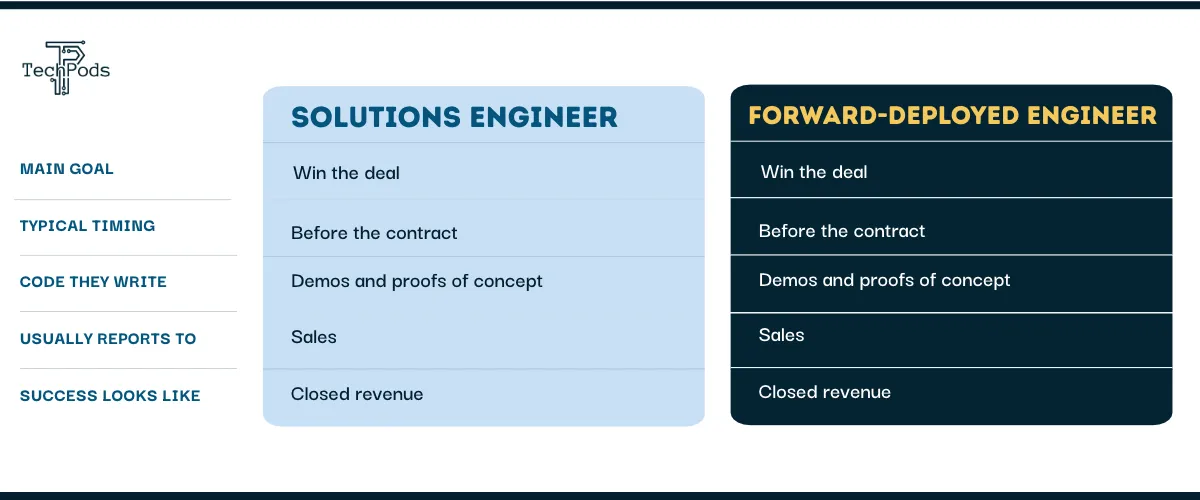
A solutions engineer (often called a sales engineer or pre-sales engineer) supports the sales process. They do technical demonstrations, respond to security surveys, construct proofs of concept, and convince the technical team of the client that the product will function. Their work on that account is essentially finished after the contract is signed, and they proceed to the next transaction.
A forward-deployed engineer usually arrives around the point where the solutions engineer leaves. Their job is to make the product work inside the customer's real environment, with real data and real users, and to keep going until it's in production.
OpenAI's own job description for a forward deployed engineer makes the split visible. The FDE works alongside OpenAI's account and go-to-market teams to scope the engagement and agree on success criteria, then takes responsibility for building and deploying the system with the customer's engineers. The sales team brings the deal in. The FDE makes it deliver.
 Forward-deployed engineer vs solutions architect
A solutions architect designs. They decide how systems, services and data should fit together, and they guide the teams who build them.
AWS, which has employed solutions architects since 2009, describes the role in its training blog as reviewing workload architectures, shaping technical strategy and advising customers on best practices. That is meaningful work. It is also largely guidance. The architect creates the plan and verifies that the build adheres to it.
The plan is designed and constructed by an FDE. In reality, a competent FDE produces a good deal of architecture, particularly in the early stages of an engagement, but they are evaluated based on whether the outcome is successful rather than how neat the diagram appears.
If your problem is "we don't know how this should be designed", a solutions architect is a good fit. If it's "we know roughly what we need and it still isn't working", you need someone who'll get hands-on.
Forward deployed engineer vs software engineer
Every FDE is a software Engineer. Not every software Engineer works like an FDE.
The technical standard remains unchanged. What differs is the scope and the setting. A software Engineer on a product team typically builds features that a large number of customers will use, working from requirements that have already been shaped by someone else. Palantir, the company where the FDE title originated, refers to these Engineers as "Devs".
An FDE works the other way round. They focus on one customer, help define the problem in the first place, and fit many capabilities together for that customer. They also spend far more time with people outside engineering. OpenAI's FDE role, for example, mentions travel of up to 50%.
Nor is either one the "better" job. A solid product team requires software Engineers who are able to dive deep into one area of the system. FDE work suits Engineers who like variety and are comfortable without a clear spec. Judgement matters in both, and more so now that AI writes a growing share of the code, a point we made in why developer judgement still wins.
Forward deployed engineer vs consultant
A consultant advises. An FDE builds.
Conventional consultants make advice, conduct workshops, diagnose issues, and present a plan. The build is often completed by someone else, though some remain to supervise delivery. It is expected of an FDE to write production code, integrate it with your systems, and take ownership of it once it is operational.
The line is blurring, though. A Forbes report from September 2026 compared two AI companies with different views. One builds FDEs into its offer from the very first conversation. The other still prefers a classic consulting approach, with discovery workshops before any engineering commitment, but now uses AI tools to turn those workshops into working prototypes within days. Both of them repeatedly hit the same problem: business processes that exist only in people's minds and were never written down in any document.
That shared obstacle is the real point. Whichever model you choose, someone has to go and find out how the work is really done. A consultant writes it up. An FDE builds around it.
Forward deployed engineer vs AI engineer
An AI engineer specialises in building, tuning and evaluating AI models and the pipelines around them: retrieval systems, prompts, evaluations, model serving. The focus is the AI system itself.
An FDE concentrates on the problem the customer is facing. That problem might involve AI, and in 2026 it frequently does, so many FDEs now require strong AI engineering skills. But an FDE will also deal with the database permissions, the approval workflow and the team that doesn't trust the new tool yet. Excellent work can be produced by an AI engineer without addressing such issues.
What about customer success managers?
A customer success manager (CSM) looks after the relationship after go-live. They monitor adoption, do business evaluations, and strive for renewal. The majority don't write code.
CSMs and FDEs frequently collaborate. The FDE makes the system operational and usable. Over the ensuing months, the CSM ensures that the client continues to see value. When the handover between the two is unclear, adoption is usually the first thing to suffer.
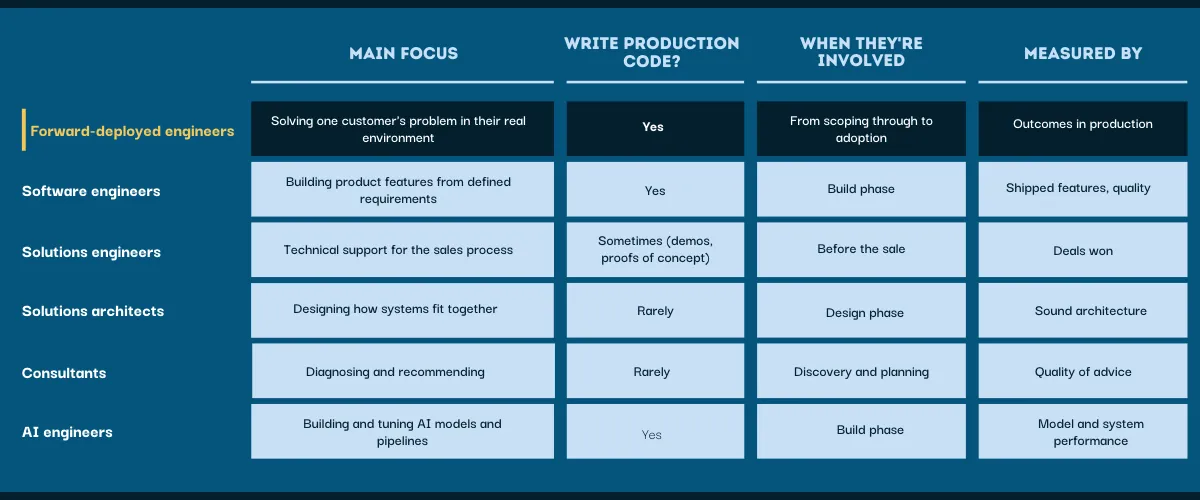 The comparison at a glance: Is "forward deployed engineer" just a fancy new name for solutions engineer?
Sometimes, yes.
The FDE title has become trendy, and certain companies have rebranded pre-sales positions in order to draw in stronger candidates. If a job ad says "forward deployed engineer" but the role reports into sales, is measured on revenue and never touches production, it's a solutions engineer role with a new name.
A real FDE role has three things a renamed one doesn't:
- Production access: They write and deploy code into the customer's live environment.
- Accountability after the sale: Their success is tied to adoption and outcomes, not to the contract.
- A feedback path into the product: What they learn in the field changes what the company builds next. OpenAI's FDE role, for example, includes working with research and product teams when customers need something today's product can't do.
Which role does your company actually need?
Start with the problem, not the title.
- You're selling a technical product and losing deals on credibility: hire a solutions engineer.
- You're planning a complex system and need it designed properly: bring in a solutions architect.
- You don't yet know what the problem is: a consultant or a short discovery phase may be the right first step.
- You know the problem, you've bought the tools, and it still isn't working in practice: that's FDE territory.
Normally, many businesses require more than one of them. When the handovers are clear, the roles complement each other. When one person is asked to perform all five tasks or when no one owns the outcome once it goes live, problems arise.
If you're planning headcount at the same time, it's also worth separating roles from capacity. Our article on forward-deployed engineer vs FTE covers that difference.
How we approach it at TechPods
Our Engineers don't sit in a sales function or hand over a slide deck. They work with our clients' products, join their teams, and have direct conversations with those who are having issues. Therefore, we can assist a customer who has a platform project that has stopped or an AI integration that is stuck at the pilot stage by putting it into production and sticking with it until people are really utilising it.
We hire for the full profile this article describes: strong engineering first, and then the judgement and communication that let an Engineer question a requirement instead of quietly building the wrong thing. If you're trying to work out which of these roles your team is missing, talk to us.
Frequently asked questions
What is the difference between a forward-deployed engineer and a solutions engineer?
A solutions engineer supports the sales process with demos and proofs of concept, and their work is mostly done once the deal closes. A forward-deployed engineer works after the sale, building and deploying the solution in the customer's real environment and staying with it until it's in use.
Is a forward-deployed engineer the same as a solutions architect?
No. A solutions architect designs how systems should fit together and guides others in building them. A forward deployed engineer designs and builds, and is measured on whether the solution works in production.
What is the difference between an FDE and a consultant?
A consultant diagnoses problems and recommends solutions. An FDE writes production code, integrates it with your systems and owns the result. Some consultancies now employ FDEs, so the line is starting to blur.