Same AI tool, different results: why developer judgment still wins
- Business
- Tech

One of the most common assumptions we hear is that two developers will get the same outcome from the same AI tool, working from the same backlog and on the same team. That's the assumption most decisions are quietly built on: buy the tool, roll it out, watch productivity rise evenly across the team.
Our experience shows that it doesn't go like that. Each developer works with AI in their own way. One person takes every suggestion as a starting point, tests it with an edge case that the ticket didn't talk about, and ships something that a reviewer hardly needs to look at. The other person takes the answer that works, moves on to the next ticket, and leaves a rewrite for whoever is on call when it fails. Same subscription. Same model. Same morning standup. Different Thursday.
We've written before about how AI doesn't replace Engineers; it reveals which ones are elite. This article goes further into the part CTOs actually have to plan around. We will cover why identical tools, handed to different people, don't converge toward one result and why they actually diverge. We will also try to prove our point of view by showing real-world experiments, inside individual teams and inside entire companies.
How is AI affecting the tech industry? The same bet, different results
If this only happened between individual developers, it would be an interesting quirk. It isn't. Run the same experiment at company scale, with the same generation of tools and comparable budgets, and you get the same spread of outcomes.
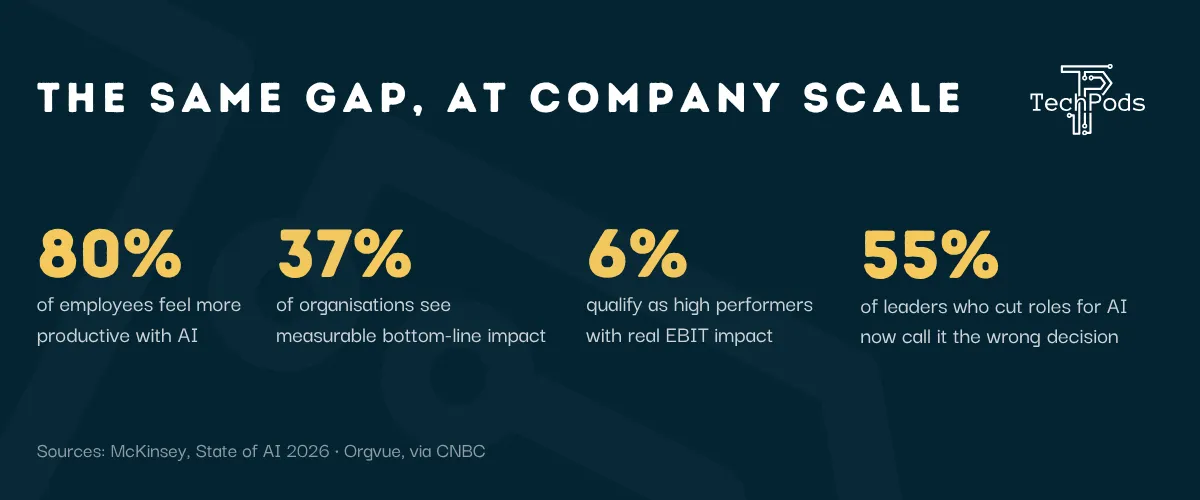
PwC's 2026 AI Jobs Barometer put a number on it: productivity growth is running 40% higher at the companies most exposed to AI than at the companies least exposed to it, and the top fifth of exposed companies average a striking 163% productivity gain. Meanwhile, McKinsey's 2026 State of AI survey found 80% of individual employees genuinely feel more productive using AI day-to-day, and half say it helps them make better decisions. Yet only 37% of organisations can point to any measurable bottom-line impact from it, and just 6% qualify as what McKinsey calls high performers, seeing real, significant EBIT impact. Nearly everyone has access to the same generation of tools. Very few get the same result from them.
 You can see this play out in public at companies where most people already have opinions. Reuters reported in October 2025 that Amazon was planning up to 30,000 job cuts as CEO Andy Jassy pushed to cut bureaucracy and lean harder on AI. Nine months later, Reuters reported again: some of the next round of cuts landed inside Amazon's own artificial general intelligence group, the team building the technology in the first place. Betting big on AI didn't automatically mean Amazon got certainty out of it, even for the team closest to the bet.
SAP ran a messier version of the same test. CEO Christian Klein froze most hiring in 2026 to redirect budget toward AI, telling the New York Times he expects "a very, very different workforce" within a few years. And yet, according to the same reporting, SAP's overall headcount kept rising anyway, adding more than 3,500 net new roles since its last cost programme, many of them customer-facing Engineers building AI products. A hiring freeze and workforce growth, at the same company, in the same breath. Salesforce's version is similarly tangled: CEO Marc Benioff said AI agents let him "rebalance" support headcount from 9,000 to about 5,000, though Salesforce itself has since described much of that shift as redeployment into sales and customer success rather than a straightforward layoff. Even inside a single announcement, the "AI did this" story turns out to be more complicated than the headline.
Does AI replace Engineers? Why the tool isn't the deciding factor
The given examples in the text about leads to the same gap
Every one of those examples points to the same gap- the same or similar AI capability inside organisations that get different, and often contradictory, results from it. That should be a strange finding if you believe the tool is doing most of the work. It's an unsurprising one if you don't.
An AI coding assistant doesn't have an opinion about your architecture. It doesn’t know that the quick fix the AI coding assistant just generated will quietly break a feature three sprints from now because it is not holding the context of what that feature depends on. The AI coding assistant generates the likely next piece of code given the prompt the AI coding assistant was handed. Whether that's the right code for this particular system, this particular load, this particular edge case, is a judgement call. It was always a judgement call. AI just made it faster to skip.
That's the part the "will AI replace developers" debate keeps missing. The AI tool is treating every user identically, and it isn't biased in the sense that it favours strong developers over weak ones either. In addition, it reflects whatever judgement was already in the room, faster, and with more code attached to it.
Why companies are rehiring Engineers after AI layoffs
2025 and 2026 were the two years most companies made confident AI bets. They made some decisions and were forced to reverse them once the AI ran into a situation it couldn't judge correctly. That reversal is the clearest proof of all.
Ford spent years pushing AI deeper into its manufacturing quality process, betting the technology could catch defects as reliably as an experienced inspector's eye. It couldn't. Bloomberg's reporting, covered by Forbes, found Ford brought back 350 veteran Engineers, nicknamed "grey beards," specifically because the automated systems couldn't tell a defect that mattered from one that didn't. Charles Poon, Ford's VP of vehicle hardware engineering, put it plainly: "Artificial intelligence is a fantastic tool, but it's only as good as the information you use to train it." The returning Engineers didn't just fix cars. They rebuilt the data pipelines feeding Ford's AI and mentored the junior staff who'd need to make the same calls once the veterans moved on again. The result, reported the same month, was Ford topping JD Power's mainstream quality ranking for the first time in sixteen years.
Ford wasn't alone. CNBC reported in July 2026 that Commonwealth Bank of Australia cut more than 40 customer service roles and replaced them with an AI voice bot, only for call volumes to rise and the bank to reverse the cuts. IBM had a related experience from the other direction: its HR chatbot handled about 94% of routine requests capably, but the remaining 6%, the ethical dilemmas and judgement calls, needed a human. IBM's response was to announce it would triple US entry-level hiring rather than shrink it further. "If we don't continue to invest in entry-level hires, what happens in three to five years? There's no pipeline. The well simply dries up," said Nickle LaMoreaux, IBM's chief HR officer. Klarna ran the same experiment even earlier, replacing roughly 700 customer service agents with an OpenAI-powered assistant, then rehiring humans once quality slipped. "We focused too much on cost," CEO Sebastian Siemiatkowski told Bloomberg. "The result was lower quality."
None of this is a rounding error. Workforce analytics firm Orgvue found that 39% of business leaders made redundancies because of AI, and of those, 55% now admit the decision was wrong, according to reporting cited by CNBC. Separate data from staffing firm Robert Half, also reported by CNBC, found that 32% of US hiring managers eliminated a role primarily because of AI and later rehired for the same or a similar position. Each of these four companies, spanning four distinct sectors, tells the exact same core story: the software didn't fail due to an inherent flaw. Rather, it fell short because no one had instructed the system - or the teams managing it - on how to define quality when facing scenarios absent from its training dataset. Experience closed that gap. Nothing else on offer could.
Why the same AI suggestion gets different results from different Engineers
Let’s go back to the two developers from the start of this article. The gap between them isn't a personality difference. It's a sequence of small decisions, and it's worth walking through slowly, because most of it happens in about ninety seconds and never shows up in a retro.
The AI assistant suggests a function. Both developers see the same fifteen lines. The first developer reads them properly, notices the suggestion doesn't handle what happens when the input array is empty, and either fixes it or flags it before moving on. The second developer reads them fast enough to confirm it looks plausible, runs the existing test suite, sees green, and ships it, because the existing tests were never written to cover that case either.
Nothing about that second decision is lazy. It's actually the more common failure mode precisely because it looks like due diligence. Tests passed. Code compiled. The pull request even got a quick approval, because reviewers are busier than ever and a clean-looking diff earns less scrutiny than a messy one. The bug shows up three weeks later, in production, on the one day the input array happens to be empty. Nobody can say the AI tool caused it. It generated exactly what it was asked to generate. What was missing wasn't better AI. It was someone asking one more question before the merge button got pressed.
Multiply that ninety-second decision across a sprint, a quarter, a year, and you get the 40% productivity gap PwC found between AI-exposed companies, or the gap between a confident headcount bet and whichever company's AI rollout quietly needs walking back next. It's the same ninety seconds, just repeated at a different scale.
How AI is changing what companies look for when hiring Engineers
None of this is staying theoretical for long. Hiring and pay are already shifting to reflect it.
PwC found that skills requirements in the roles most exposed to AI are evolving at more than twice the rate of less-exposed roles, and that the new tasks landing inside those roles lean 2.5 times more heavily on judgement, empathy and creativity than the tasks they're replacing. Even more telling for anyone hiring junior developers: the most AI-exposed entry-level roles are now seven times more likely than the least-exposed ones to demand traditionally senior skills, like leadership and independent judgement, straight out of the gate. Wages are following the same line. Roles that PwC classifies as "professionalised" by AI, meaning judgement and oversight became a bigger part of the job rather than a smaller one, have seen wage growth 42% faster than roles AI simply made easier to enter.
Put plainly, the market isn't rewarding "knows how to use the AI tool" any more. 90% of teams already do. It's rewarding the judgement to know when the tool's answer is good enough to ship, and when it isn't, at exactly the moment that judgement is hardest to fake and easiest to test for.
What this means for CTOs hiring Engineers in the AI era
If the tool were the deciding factor, the fix would be simple: license the best model, roll it out, wait for output to rise evenly. Nobody sizing a team in 2026 has that luxury, because the evidence, from PwC's company-level data down to Ford's factory floor, says the tool amplifies whatever judgement was already in the room. It doesn't install new judgement where none existed.
That's the exact reasoning behind sizing teams around capability rather than headcount, and it's why the comparison between ten developers and three elite Engineers keeps coming up in board conversations this year. Ten AI licences handed to ten average developers produce ten times the code and roughly the same amount of judgement as one licence handed to one average developer. Three licences handed to three Engineers who already know when to trust a suggestion and when to override it produce something closer to what Ford, CBA and IBM eventually had to rehire for, at a fraction of the cost of learning that lesson the way they did.
This is what Elite Systems. Elite Teams. actually means day-to-day at TechPods. We don't evaluate the Bulgarian Engineers we build dedicated teams around based on which AI tools they've used. We look at the decision that determines whether an AI suggestion goes out as it is, gets changed away or gets flagged before it even reaches a reviewer. If you're trying to work out whether your next hire, or your current team, sits on the right side of that gap, talk to TechPods before the next AI licence renewal goes to the board instead of after.
Frequently asked questions
Why do two developers get different results from the same AI coding tool?
Because the tool generates the statistically likely output for a given prompt, not the correct one for a specific system, load or edge case. Deciding whether that output is good enough to ship is a judgement call the AI doesn't make. Developers with stronger judgement catch what the tool misses; developers who accept the first plausible answer ship what it misses along with it.
How many companies regret their AI-driven layoffs?
More than half. Orgvue found 55% of leaders who made AI-driven redundancies now call it the wrong decision, and Robert Half found 32% of US hiring managers rehired for a role they'd cut because of AI. Ford, Commonwealth Bank of Australia and IBM are among the clearest public examples of that regret playing out.
How is AI changing what companies look for when hiring developers?
PwC's research found the most AI-exposed junior roles are now seven times more likely to demand senior skills like leadership and independent judgement than roles with less AI exposure, and that wages are growing 42% faster in roles where AI raised the judgement bar rather than lowering the skill bar.