What Is a Forward Deployed Engineer? The Complete Guide for 2026
- Business
- Tech

Forward-deployed engineer, or FDE as most people call it, is a term you hear more and more often. Chances are it’s come up at least once in the past six months, whether from your own team or somewhere else. Maybe it was after an AI pilot stalled. Maybe a board member read about it. Either way, a term that used to belong to a handful of tech companies has moved into ordinary planning conversations very quickly, and it's not always clear whether people mean the same thing when they say it.
This guide is suitable for the person who has to decide what to do about it. We'll cover what a forward-deployed engineer is, where the role came from, what FDEs actually do day to day, how they compare with the roles they get confused with, and when a business really needs one.
What is a forward-deployed engineer?
A forward-deployed engineer is a software engineer who is working directly with a customer, inside their systems and data, to understand a problem, build the solution, and get it working in real use. The "forward" part means they are located near the problem, not back at headquarters. They don't get a polished specification and go off to build it. They help write it.
McKinsey's Holger Hürtgen puts the distinction simply in a recent McKinsey explainer: an FDE is first of all an Engineer, but one who works on client systems instead of in a lab. That's the idea in one line. The technical bar is the same as for any software engineer. The setting, the responsibility and the finish line are different.
What does FDE stand for?
As it was mentioned above the FDE stands for forward-deployed engineer. You'll also see FDSE which stands for forward-deployed software engineer. Some companies write it with a hyphen (forward-deployed engineer), and some add "AI" to the front. They all describe roughly the same role.
Where did the forward-deployed engineer role come from?
From Palantir's "Deltas" to AI labs
The title comes from Palantir. Palantir’s Engineers were frequently embedded with government and enterprise customers who couldn’t simply email their issues to them. So Palantir sent people to work alongside them instead.
During a 2020 interview with one of its FDSEs, the company outlined two types of Engineers. A "Dev" develops a single capability that numerous customers are able to use. A "Delta" works the other way around, combining many capabilities for a single customer.
The role stayed a fairly niche one for about a decade. Then generative AI appeared, and companies selling models and platforms realised their customers couldn't get much out of them without hands-on help. The FDE title spread from Palantir to AI labs, then to cloud providers, and more recently to consulting and IT services firms.
What does a forward deployed engineer actually do?
The daily responsibilities vary a lot between companies. But the pattern underneath is pretty consistent.
They start by watching how the work is done
A good FDE spends time with the users of the system before writing anything. McKinsey's Martin Harrysson describes the first weeks of an engagement as sitting next to the team doing the task, working out who makes decisions and which data actually matters. Much of that knowledge has never been written down anywhere. You can only discover it by being present in the room.
They prototype against real data
Demo data is well organized. Production data is not. FDEs create early versions against the customer's actual systems, and that is where the difficult issues surface: up: missing fields, odd permissions, a legacy database no one wants to deal with. Uncovering these in week two costs far less than discovering them after launch.
They ship to production and stay until it's used
This is the part that separates an FDE from almost every adjacent role. The job isn't finished when the code is merged, or when the client signs off a demo. It's finished when people are using the thing, and it's changing how they work. If adoption stalls, that's still the FDE's problem.
Mihail Panayotov, our CTO and Co-Founder, sees this as the core of the role:
"A good forward-deployed engineer measures their week by what changed for the people using the system, not by how much code they wrote. Sometimes the most useful thing they do is talk the client out of building a feature nobody would have used."
Why is everyone hiring forward deployed engineers right now?
Because buying AI turned out to be far easier than making it work.
It is possible to license a model in the afternoon. It's a completely different task to connect it to your customer records, approval routines, and compliance regulations, and for any of it to matter, the individuals using it still need to alter their workflow. Hürtgen states it plainly in the McKinsey article: absent that customization, companies watch their token spending rise while nothing shifts on the bottom line.
The hiring numbers reflect that gap. Kello's 2026 FDE hiring report, based on more than 15,000 FDE job postings, counted 4,220 new postings in Q3 2026 compared with 857 in Q3 2025. That's almost five times as many in a year. According to the same research, AWS currently operates its deployment teams as pods of five to six engineers working in 45-day sprints, and several of the biggest AI startups deployed specialised deployment units between May and July 2026.
Not everyone believes the label is new, and that doubt is justified. Hürtgen, who has done this kind of work for two decades, admits in the McKinsey interview that "the FDE terminology itself is maybe a bit of a buzzword." The concept isn't. What's changed is that AI made the cost of skipping it obvious.
"The title is new. The job isn't. Good Engineers have always gone and sat with the people who had the problem. What AI changed is how expensive it is when nobody does. You can now buy a very capable tool and still get nothing out of it." - Mihail Panayotov, CTO & Co-Founder, TechPods
FDE vs other engineering roles: a quick comparison
The FDE role overlaps with several others, which is why job titles get used loosely. Here's how they differ in practice.
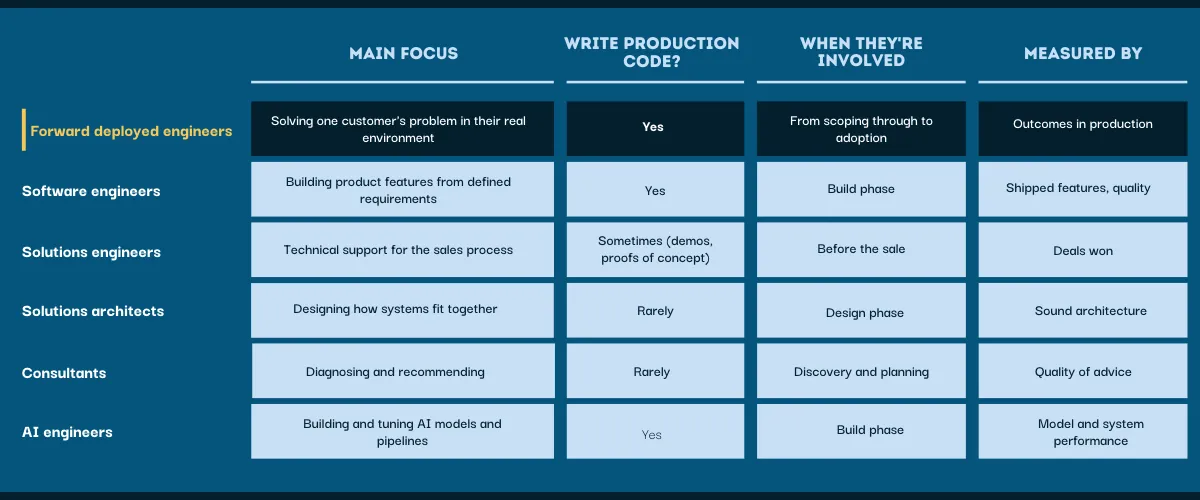
The short version: every FDE is a software Engineer, but their involvement covers the whole journey, from defining the problem to seeing the solution used every day. And where a consultant hands over a plan, an FDE hands over a working system.
There's one more comparison that matters for anyone planning headcount, and it isn't a role at all. FTE (full-time equivalent) measures capacity, while FDE describes responsibility. We unpack that difference in forward-deployed engineer vs FTE.
What skills does a forward-deployed engineer need?
The priority is strong engineering. Writing production code across the stack, working with APIs and data pipelines, and deploying to cloud infrastructure - often in an environment they didn't design - are all requirements for an FDE. In 2026, that increasingly includes building with large language models, and knowing how to evaluate what they produce.
The other half of the job is less visible on a CV. Salesforce's guide to the role lists problem-solving, communication, business acumen and a learning mindset next to technical skill, and that matches what we see. An FDE has to explain trade-offs to someone who doesn't care about the stack. They have to notice when a request doesn't match the underlying need, and say so.
Harrysson's description in the McKinsey article is a good one to borrow: the best people in this role resemble multisport athletes in some ways. They are technical enough to grasp how the system operates. And they are comfortable enough with people to figure out how decisions are actually made.
That combination is rare, and it's also what we look for more generally in what makes an Engineer elite.
How much does a forward-deployed engineer cost?
Pay for FDEs often follows the salary of senior software engineers, with a premium at the top of the market. Kello's report suggests employers in the US can usually hire at their senior software Engineer band, which it puts at roughly $150,000 to $230,000. AI labs and major tech companies compensate experienced FDEs far more than that, which is what drives the headline numbers upward.
Salary is only part of the cost, though. Hiring an FDE in-house also means recruitment fees, a long search for a rare profile, ramp-up time, and the risk that a well-paid specialist gets poached six months in. For many companies, especially scale-ups, getting the same way of working through an embedded team is the quicker route.
When does a business need a forward-deployed engineer?
Not every company does. If your work is clearly defined, your requirements are well understood, and your Engineers already have direct contact with users, you may already have everything you need.
The FDE way of working tends to pay off when:
- You’ve invested in AI or a new platform, but it isn’t being used. The tool performs well in a demo but fails to gain traction in the business.
- Requirements continue to get lost between the business and engineering teams, with each handover introducing another layer of interpretation.
- The issue spans disorganised systems that are badly documented. Someone needs to investigate how things actually operate.
- Success depends on people changing how they work, not just on new software being available.
- You need production results quickly and can't afford a long discovery phase followed by a separate build.
Common misconceptions about forward-deployed engineering
A few ideas come up often enough to address directly.
"An FDE is just a solutions engineer with a new title." Sometimes, that is the case, so it is worth verifying when reviewing a job advertisement. A real FDE writes and maintains production code after the sale, while a solutions engineer primarily works before the sale.
"Embedding an Engineer in our team makes them an FDE." Proximity doesn't create ownership. You can put an Engineer in every standup and still hand them tickets that someone else wrote. What makes the difference is context, direct access to stakeholders, and the authority to question a requirement.
"FDEs are only for AI projects." The title grew up long before generative AI. Any project where the hard part is fitting software into a real organisation benefits from the same approach.
"You need to hire them in-house." Some companies do. Many get the same result from a partner whose Engineers work inside their team with the same access and accountability. What counts is how the Engineers work, not whose payroll they sit on.
"Most companies don't need someone with 'forward deployed' on their badge. They need Engineers who are allowed to ask why before they build, and who are still around when the thing goes live." - Mihail Panayotov, CTO & Co-Founder, TechPods
Is a forward-deployed engineer a good career?
A short note for the Engineers reading this.
For the right person, absolutely. The role offers strong compensation, is in high demand, and develops a rare combination of skills: production engineering, product thinking, and genuine accountability for outcomes. Kello's data shows that between 29% and 39% of FDEs were software Engineers in their previous job, so this isn't a role reserved for people with unusual backgrounds.
It isn't for everyone, though. You'll switch context often, deal with ambiguity most weeks, and spend a fair amount of time explaining technical decisions to people who aren't technical. If you enjoy that, it's one of the most interesting jobs in engineering right now.
Is the FDE model right for your organisation?
Three questions usually settle it.
1. Is your problem mainly about building, or about fitting something into how the business works? If it's the second, FDE-style work will help.
2. Do your Engineers have direct access to the people with the problem? If everything reaches them through layers of tickets, the gap is in how work flows, and more headcount won't close it.
3. Who owns the outcome after launch? If nobody does, that's often the most important gap of all.
If the answers point towards FDE-style work, the next decision is how to get it: hire, partner, or reshape the team you already have. Our capacity vs capability framework is a useful place to start that conversation.
Forward-deployed engineering at TechPods
We didn't start TechPods to sell forward-deployed engineering. Looking at how our teams work, though, most of the principles are already there.
Our Engineers join our clients' teams directly. They work in the same tools, attend the same standups and talk to the same stakeholders as everyone else on the team. Our co-sourcing model is built around deep integration and shared ownership, so the client keeps control of the roadmap, and our Engineers take responsibility for what they build. When a client needs a specific problem solved, such as getting an AI integration from pilot to production, our forward-deployed engineering service puts Engineers inside their team with one clear goal: get it working in production, and make sure people actually use it.
We also hire for the profile this guide describes. Strong technical foundations, yes, but also judgement, clear communication and the confidence to challenge a requirement when it doesn't make sense. That's what Elite Systems. Elite Teams. means in practice, and it's why a small pod of the right Engineers will often get further than a bigger team waiting for clearer tickets.
If you're trying to work out whether your next step is a forward-deployed engineer, a different kind of team, or a change in how your current Engineers work, talk to us. It's a conversation we have with CTOs every week.