
The demonstration was a success. The AI assistant provided instant answers regarding last quarter's orders, prompting the leadership team to request a rollout strategy and leading the group to schedule a celebratory lunch. But six months later, it’s still a demo. It functions with the sample data used during development, but fails on the full order history. Integration with the ERP system is "in progress." The customer service team, intended to be daily users, has quietly reverted to using spreadsheets. The project has lost all impetus, even if it hasn't been formally cancelled.
This is precisely where most AI projects stall: in the gap between a compelling proof of concept and a system that users actually rely on. This article looks at why that happens, what the research says, and how forward-deployed engineering gets AI projects out of the pilot stage and into production.
AI is easy to buy. Getting it into production is the hard part.
It has never been cheaper or easier to access powerful AI models. However, implementing these models to perform productive work within a business is another challenge entirely, and the data reflects how frequently these efforts fail.
- S&P Global Market Intelligence found that the share of companies abandoning most of their AI initiatives before production rose from 17% to 42% in a single year, with the average organisation scrapping 46% of its proofs of concept.
- Gartner predicted in 2024 that at least 30% of generative AI projects would be abandoned after proof of concept by the end of 2025, pointing to poor data quality, weak risk controls, rising costs and unclear business value.
- A 2025 report from MIT's NANDA initiative, covered by Fortune, found that around 95% of enterprise generative AI pilots delivered little or no measurable impact on profit and loss.
Because every study measures things a little differently, the precise numbers change. The direction doesn't. Businesses are much better at initiating AI initiatives than they are at completing them, and the industry refers to this gap as "pilot purgatory."
Why do AI projects get stuck in proof-of-concept?
Rarely because the model isn't good enough. The RAND Corporation interviewed experienced data scientists and Engineers about why AI projects fail, and the most common reason wasn't technical at all. The problem was that the people involved didn't clearly communicate what the AI was supposed to do, or they misunderstood its purpose.
In our experience, stalled projects tend to share some combination of the following.
Nobody agreed what success looks like
Most pilots start with "let's see what AI can do with our data". While this is a reasonable experiment, it is not a good basis for making a business decision.
Without quantifiable metrics, such as hours saved per week, tickets resolved without escalation, or errors caught before invoicing, it is impossible to determine the success of a pilot program. A project that fails to demonstrate its value will struggle to secure the funding required to move forward. Gartner's own research lists unclear business value as one of the main reasons generative AI projects get dropped.
The demo used clean data. Production doesn't.
A proof of concept is usually built on a small, carefully chosen dataset. Production means every record, including the duplicates, the missing fields, the three versions of the same document and the spreadsheet only one person understands.
Gartner found in a 2025 survey of more than 1,200 data management leaders that 63% of organisations either lack the right data management practices for AI or aren't sure whether they have them. According to the prediction, 60% of AI projects that lack AI-ready data will be abandoned by businesses by 2026. A pilot has not truly been tested if it has never interacted with actual data.
Nobody owns the integration
This is the most prevalent pattern: one team develops the model, another manages the infrastructure, a vendor operates the platform, and a business unit owns the process the AI is intended to enhance. When something doesn't work, each of them can reasonably say it's someone else's job.
AI rarely creates value on its own. It has to connect to the CRM, the ERP, the document store, the approval workflow and the security rules. That integration work is unglamorous; it cuts across team boundaries, and if nobody is clearly responsible for it, it doesn't get done.
Requirements get lost in translation
The company informs a project manager of its requirements. For the data team, the project manager drafts it. What is described in the text is built by the data team. By the time the system reaches the people who'll use it, it solves a slightly different problem from the one they have.
RAND's first recommendation for avoiding AI project failure is to make sure technical staff understand the purpose and context of the project. Every handover makes that harder.
The people doing the work never changed how they work
A technically impressive system that doesn't fit how people work will be ignored. If the AI tool sits in a separate window, adds steps to an already busy process, or gives answers nobody trusts, staff will go back to what they know.
This is the core of the issue, according to MIT research. Although generic AI tools are sufficiently adaptable for individuals, they stall in enterprises due to their inability to adjust to the workflows surrounding them. The value comes from redesigning the work and the tool together, not from adding AI on top of a process that stays the same.
The team keeps reaching for a new model
When a pilot underperforms, it is tempting to blame the technology and pivot to a new model, framework, or vendor. However, every switch restarts the process. The demo appears amazing again, but on the other side are the same adoption, data, and integration challenges.
What does forward deployed engineering change?
Forward-deployed engineering exists because of exactly these problems. A forward-deployed engineer (FDE) works inside the business, alongside the teams who will use the system, and stays responsible for it until it's working in production and being used.
Mapped against the causes above, that changes a lot:
 OpenAI describes its own FDE engagements in similar terms: start by defining the business value, get a useful system into people's hands quickly, improve it through real use, then turn what works into something the wider business can reuse. The order is crucial. Scale comes last, actual utilisation comes second, and value comes first.
When does your business need a forward-deployed engineer?
Not every stalled project requires an FDE. Some simply need a stronger business case or a decision to be terminated. However, if several of the following conditions apply, an FDE-style approach is likely to be beneficial:
- Your pilot worked in the demo but has been "almost ready" for more than three months.
- Nobody can name the one person responsible for getting it into production.
- The integration work is split across several teams or vendors, and each one is waiting for another.
- The intended users weren't involved in building it, and adoption since launch has been low.
- You've already switched models or vendors at least once without moving any closer to production.
If three or more of those sound familiar, the problem probably isn't your AI. It's how the workaround is organised. Our complete guide to forward-deployed engineers covers the role in more detail.
What do the first 90 days of an FDE engagement look like?
Every engagement is different, but a well-run one usually follows a similar shape.
Weeks 1 to 3: understand the work and agree the target. The Engineers discover the data and systems involved, map out how the job actually occurs, and spend time with the teams that will utilise the system. By the time it's all over, there's a clear judgement on what not to build and a single agreed-upon metric of success.
Weeks 4 to 8: build against reality. A first working version goes into the hands of a small group of real users, connected to real data. This is where the difficult challenges emerge, ranging from disorganised records to access controls, and where they are resolved immediately rather than merely documented for later.
Weeks 9 to 12: get it into production and into use. With appropriate security, support, and monitoring, the system enters the live environment. The Engineers stay close to the users as adoption grows, fix what breaks, and measure the result against the target agreed in week three.
By day 90, you should be aware of whether the project is yielding results. If it isn't, you'll understand the reason, which is much more beneficial than spending another six months in pilot limbo.
When should you stop an AI pilot instead?
Getting a pilot into production isn't always the right answer. Stopping is the better call when:
- There's no realistic business case, even with the data and integration fixed.
- The task is beyond what current AI can do reliably. RAND lists this among its five root causes of failure.
- The process it supports is about to change for other reasons.
By day 90, you should be aware of whether the project is yielding results. If it isn't, you'll understand the reason, which is much more beneficial than spending another six months in pilot limbo.
What if you don't need a full-time FDE?
Most companies don't. Building an in-house FDE team takes time, a high hiring bar and a generous budget, and many AI projects need intensive engineering for months, not years.
The good news is that collaboration is encouraged by the research. According to the MIT study, AI initiatives carried out through partnerships and specialised suppliers were successful roughly 67% of the time, whereas internal builds were only about a third as successful.
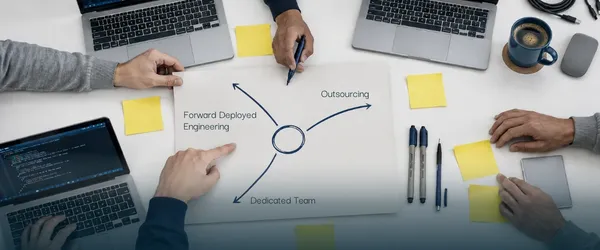
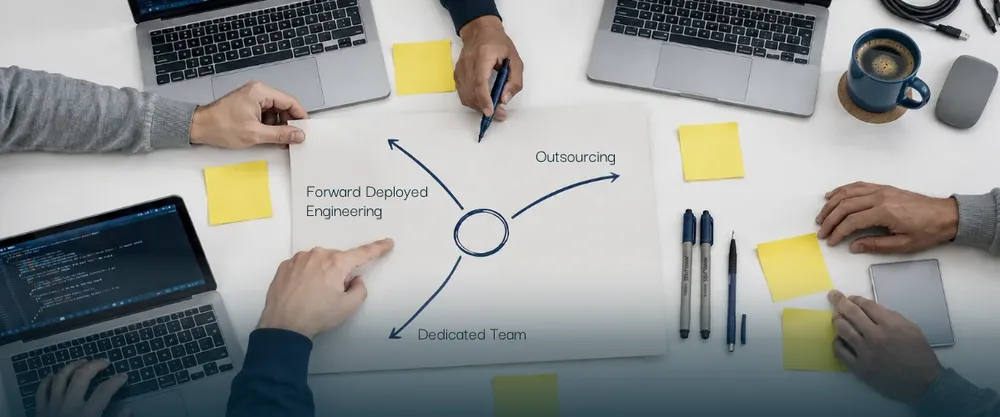
The partner's proper performance is what counts. When Engineers from outside your company produce against a specification, they will encounter the same handover issues that initially caused the pilot to stall. Engineers who join your team, work in your tools and talk to the people using the system can do what an FDE does without the cost of a permanent function. We compare the options in more depth in FDE vs outsourcing vs a dedicated team.
It also helps to fix the team around the AI, not only the AI itself. If the underlying engineering is weak, no tool will compensate- a point we made: AI won't fix a weak engineering team. And the Engineers you bring in should know how to orchestrate AI rather than just use it.
How we help get AI projects out of the pilot stage
Our Engineers are part of our clients' teams. They use the same tools, take part in standups, and interact directly with the consumers of the products they develop. Through our co-sourcing model, the knowledge stays in your business, and your team keeps control of the roadmap.
That's exactly what a stalled AI project tends to need: Engineers who'll get to grips with the real data, own the integration, and stay until the system is in daily use. If your AI pilot has been "almost ready" for longer than you'd like, talk to us.