How to hire AI-native engineers in 2027: what to look for
- Career Talks
- Business

Tobi Lütke, the CEO of Shopify, informed his employees in April 2025 that "reflexive AI usage" was now expected. Teams would have to demonstrate why AI couldn't do the task before requesting an increase in staff. Eighteen months later, most of the CTOs we interact with still have that guideline in place. However, what far fewer of them have is a clear picture of who they should be hiring once it's there.
"AI-native" is now used on both resumes and job descriptions. It seems like a precise ability. In reality, it's frequently a list of tool names. This blog explains what the term should really imply when you're hiring for 2027, how to test for it without adding five rounds to your process, and how to distinguish the signals that separate the real thing from the label.
What is an AI-native Engineer?
An AI-native Engineer views AI agents as a standard component of software development. They specify what needs to be done, provide agents with the proper context and task sizes, and assume complete accountability for output verification. Manually writing code is not the default; it is one of numerous options.
Augment Code, which builds AI coding tools, published its own hiring criteria in 2026 and described the shift neatly: the Engineer moves "from author to architect and editor". Its six hiring dimensions include product taste, architectural judgement, agent leverage and learning speed. Raw coding ability isn't one of them as a standalone item. Not because it stopped mattering, but because it stopped being what separates good Engineers from exceptional ones.
Is an AI-native Engineer the same as an AI Engineer?
No, and mixing the two up is one of the most common mistakes we see in job descriptions.
- An AI Engineer builds AI into products: model integrations, retrieval pipelines, evaluation systems. It's a specialism.
- An AI-native Engineer is defined by their way of working. They could be a backend developer in Java, a QA Engineer or a mobile developer.
A machine learning expert can operate in a relatively conventional manner. A backend developer for payments can be fully AI-native. You'll draw in the wrong kind of applicants and have to spend weeks vetting them if you include "AI Engineer" in the title when you mean the second.
Why is it so hard to spot AI-native skills on a CV?
Because everyone lists them now.
The World Economic Forum's Future of Jobs Report 2025 put AI and big data at the top of the fastest-growing skills, and employers expect 39% of key skills to change by 2030. The same reports have been read by candidates. Nearly every senior CV we review has Copilot, Cursor, and Claude Code on it. None of that indicates whether you can rely on the person using those tools.
And that trust is the whole point. Veracode tested more than 100 language models for its 2025 GenAI Code Security Report. 45% of the code samples failed security tests and introduced OWASP Top 10 vulnerabilities. For cross-site scripting, the models failed to defend against it in 86% of relevant samples. The most uncomfortable finding? Newer models wrote more functional code, but not more secure code.
When you compare the two results, the hiring issue becomes clear. Nearly all candidates can use AI to write code. Few people are able to identify which half of that code would subtly expose a flaw in your product, and a keyword search across a stack of resumes never reveals that distinction.
So the value of an AI-native engineer sits almost entirely in what happens after generation. That's also why the same AI tool gives very different results depending on who is using it.
What should you look for when hiring AI-native Engineers?
These are the seven signals we look for when we hire Engineers in Sofia. They overlap with our 10-point Elite Engineer checklist, but they focus on the habits that matter specifically when agents do a large share of the typing.
1. They write the spec before the prompt
Weak AI Engineers launch a chat window and begin to type. The first ten minutes are spent by the strong ones figuring out what "done" entails, including the inputs, edge circumstances, and limits that the agent is unable to anticipate. What transforms an agent from a slot machine into a tool is a clear specification.
2. They know what context the agent is missing
A large portion of a system's actual logic is never included in the repository. It can be found in decisions made following an incident, in old Slack discussions, or in a customer who consistently breaks items on the last day of the month. AI-native Engineers are fast to recognise when a result is "correct" for a nonexistent system, and they intentionally feed agents that context.
3. They verify by default
Line by line, they read the diffs. They create or verify tests that were not generated by the same model using the same assumptions. They consider security on their own initiative, which is no longer optional in light of the Veracode numbers.
4. They know when not to use AI
A migration with a large blast radius, a design trade-off with long-term costs, or an unclear product decision all require human judgement. Once the direction is established, AI enters the picture. The same argument is made in Canva's interview guidelines, which urge candidates to express their opinions prior to using AI.
5. They break work into pieces an agent (and a reviewer) can handle
Large pull requests produced by AI are a problem for reviewers. In order to test and assess each output in minutes rather than hours, AI-native developers break the process down into simple, verifiable phases. This is similar to how we explained how Elite Engineers orchestrate AI: the ability lies in managing the task rather than merely producing it.
6. They own the result, whoever typed it
"The AI wrote that bit" is not a suitable justification for a production error. Every line that AI-native Engineers combine can be explained, and they will go back and repair any issues without being pursued.
7. They change their workflow without chasing every new tool
The instruments move quickly. The team at Augment Code anticipates that the current toolkit will become obsolete in three months. Competent Engineers can explain their early adoption and swift drops. Find out what they quit using this year. Frequently, it reveals more than they initially did.
How do you interview an AI-native Engineer?
Let them use AI. Testing candidates in an AI-free room measures a version of the job that no longer exists.
Large employers have already moved. Wired reported in July 2025 that Meta was starting to let some candidates use AI during coding tests. Canva runs AI-assisted programming interviews and published an interviewer's guide explaining what it scores: problem-solving, technical depth and ownership, and how effectively candidates work with AI while keeping control.
HackerRank's CEO Vivek Ravisankar frames the developer role as becoming an orchestrator of AI agents.
A practical format that fits into one or two stages:
- AI enabled a fuzzy brief in an actual codebase. Instead of starting with a blank file, use an existing repository and allow 60 to 90 minutes. Before they generate, see how they explore.
- A seeded weakness. Add one AI-generated piece of code with a minor or security flaw. Does the applicant search for it or combine it?
- The explanation. Choose three choices from their solution and explain each one. Not the actions of the code. Why is it there?
- The question, "What wouldn't you delegate?" Strong candidates have a precise, well-defined response.
Give each candidate a score based on one line of evidence and the same signals. It is structured scoring that prevents two interviewers from having different opinions about the same individual.
How can you tell if a candidate relies on AI too much?
Canva's interviewers describe three patterns that don't impress them, and they match what we see:
- The AI demonstration: Very little progress on the real issue, lots of smart prodding.
- The marathon of features: Accepting outputs quickly to complete as many features as possible without sacrificing quality.
- Keep your hands off: Treating AI not as a tool to guide and monitor, but as a comprehensive solution generator.
Two more warning signs: a candidate who re-prompts instead of reading the error message, and one who can't say which parts of their solution they'd want reviewed most carefully.
Red flags that look AI-native but aren't
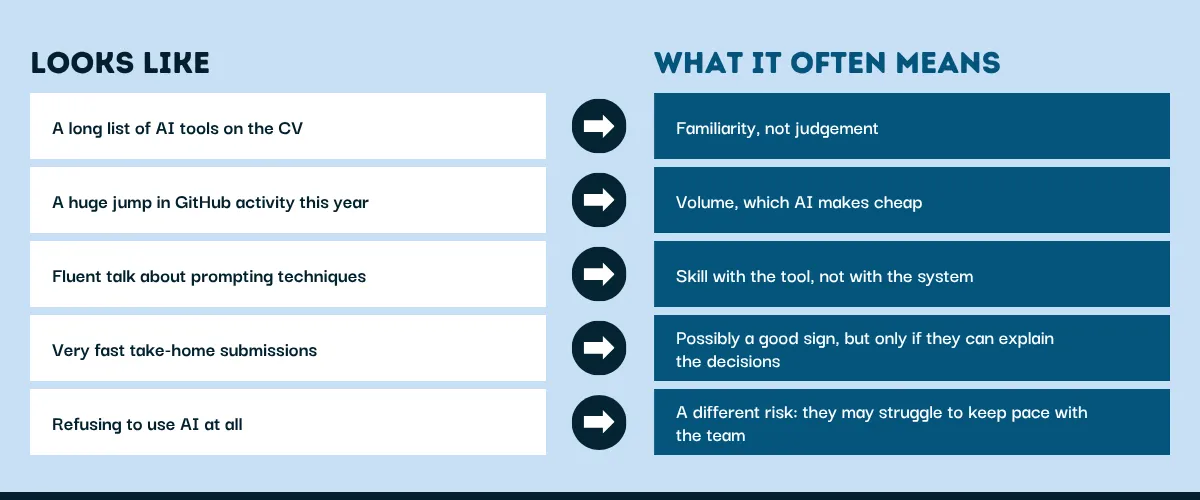
What will change in AI-native hiring in 2027?
Three shifts are already visible in the teams we work with.
- Review and architectural assessment will be given more weight.
More code enters at once when agents take on lengthier tasks. The constraint is the Engineers who are able to determine whether a change is sound for the entire system, not just the ticket. That's also why we argue for sizing teams around capability rather than capacity.
- Junior hiring will change, but it won't go away.
"AI-native early professionals" are currently hired by Augment Code, which places a high value on learning speed. Cutting every junior role saves money this year and leaves you without seniors later, a point we covered in our guide to restructuring engineering teams around AI.
- Continuity turns into a separate hiring criterion.
The context that an AI-native Engineer provides to the agent determines how effective they are. That context takes months to build and leaves the day they do. It also gets diluted when an Engineer splits time across several clients, which is why full attention on one product changes outcomes. When you assess candidates or partners for 2027, ask how long people stay, not just how fast they ship.
Candidates who enquire about your AI policy, which includes what data can be included in a prompt and which technologies are permitted, are typically those who have worked in an environment where it was important.
Where can you find AI-native Engineers?
They rarely appear in job advertisements, and a CV check won't find them for the reasons described above. Most CTOs finally have to choose between a partner who has already finished the screening, temporary contractors, or a protracted internal search.
Our co-sourcing model has been based on the signals in this guide since 2018. We hire and vet Engineers in Sofia for judgment, verification habits and ownership, then build dedicated teams that work only for one partner, inside that partner's standups, codebase and AI policy. Both our partners and our Engineers stick around; 85% of them have been with us for more than four years. For shorter needs, such as a launch or a migration, Mission Pods bring in one Engineer or a small team around your core.
If you're writing job specs for 2027 and want a second view on what "AI-native" should mean for your product, talk to us before the role goes live.
Frequently asked questions
What does AI-native mean for a software engineer?
It describes a way of working where AI agents are a normal part of building software. The engineer specifies the work, gives agents context, breaks tasks into checkable pieces and owns the verification of everything that ships.
Should candidates be allowed to use AI in technical interviews?
Yes, with a clear brief. Companies such as Meta and Canva have introduced AI-assisted coding interviews because banning AI tests a version of the job that no longer exists. The goal is to see how candidates judge and correct AI output.
Can existing engineers become AI-native?
Most of the signals are habits, so they can be learned, especially with a senior engineer who already works this way, setting the standard. Verification discipline and ownership are the hardest to teach, so they're worth testing for at the hiring stage.