What makes an Engineer Elite? A 10-point hiring checklist for CTOs

- Tech
- Business

We speak with technical directors on a daily basis, and every one of them says they want Elite Engineers. Far fewer can articulate what that actually means when a candidate is sitting across from them during an interview.
If we ask about the qualities that define a strong, Elite Engineer, everyone mentions having "strong fundamentals," being a "good communicator," or possessing an "ownership mindset."
Yes, all of that is true, it’s indisputable. However, none of it helps you choose between two candidates. And in 2026, with AI writing a significant portion of code, the difference between an Engineer who “appears” strong and one who “is” strong becomes harder to spot during an interview, and costlier to overlook.
We've already covered why AI reveals which Engineers are Elite and how Elite Engineers orchestrate AI instead of just using it. This piece is the practical version. Ten signals, and how to test for each one before you make an offer.
What does "Elite" actually mean for a Software Engineer?
An Elite Engineer is someone whose decisions you can trust without having to verify them. Yes, they write high-quality code. But their true value lies in choosing the right problem, objectively weighing the pros and cons, and leaving the system, as well as the team, in better shape than they found them.
That's not just our view. When researchers at Microsoft interviewed 59 experienced Engineers across 13 divisions, they found 53 distinct attributes of great software Engineers. They grouped them into four areas: the Engineer as a person, how they make decisions, how they work with teammates, and the software they produce. Only one of those four is about the code itself.
The study is from 2015. It has aged well, because AI has taken over a big part of that fourth area and left the other three almost untouched.
Why did the old hiring signals stop working?
For years, being able to write correct code quickly under time pressure worked as a decent stand-in for ability. It was never the real thing, but it tracked closely enough.
That link has broken. Karat, which runs technical interviews for large employers, put it plainly in a July 2026 piece on AI-era interviews: AI has made generating code cheap, and what's scarce now is the ability to evaluate and improve that output inside complex production systems. The same article cites Dice data showing 73% of US tech job postings in May required at least one AI skill. AI fluency is the baseline, not the differentiator.
Meanwhile, developers themselves don't fully trust the tools. In the 2025 Stack Overflow Developer Survey, more developers actively distrusted the accuracy of AI output (46%) than trusted it (33%). And 66% named "almost right" AI solutions as their biggest frustration.
"Almost right" is the whole problem. Someone has to spot it. That someone is the Engineer you're trying to hire.
Sifting through hundreds of modern resumes, where every applicant claims AI proficiency, has become a massive bottleneck for CTOs. At TechPods, our recruitment framework is specifically designed to target top-tier talent. Before a client ever sees a candidate, we shortlist only those who prove they can critically evaluate and refine code in real production environments.
The Elite Engineer hiring checklist: 10 signals to test for
Each of the signs listed below can be easily verified without the need for special tools. In most cases, you simply need to stop asking candidates what they “would” do and start observing what they “actually” do.
1. They treat AI output as an initial draft
Elite Engineers actively use AI, but they do not trust it blindly. Every suggestion is reviewed, tested, and very often even rejected. Weaker Engineers accept the first answer that compiles successfully, a habit that rarely shows up on their resumes.
How to test it: Give the candidate an AI-generated solution with one subtle flaw, like a missed edge case or a race condition. Ask them to review it before merging. See how long it takes them to find it, and whether they look at all.
For example, in our candidate screening at TechPods, we specifically look for developers who ask sharp business questions during technical assessments. This ensures that the engineers we shortlist for Company X won't just write code, but will solve the actual business problem.
2. They can explain every line of code they implement.
"Artificial intelligence wrote it" has never been an acceptable explanation for an error in a live system. Elite Engineers do not need office politics to understand this.
How to test it: Pick three lines from their take-home task or a past project and ask why they're there. Not what they do. Why. If the answer is vague, the understanding probably is too.
3. They identify the actual problem before proposing a solution.
If you assign a vague task to a mid-level Engineer, you will get code. The crucial nuance here is that an Elite Engineer, the kind you would entrust with such a task, will ask questions. This is the easiest way to tell them apart. You will receive questions like: "Who is this for?", "What happens if we don't build it?", or "Is there a simpler option that solves 80% of the problem?"
How to test it: Describe a deliberately fuzzy business problem. Count the clarifying questions before they start designing. Zero is a red flag.
4. They name the trade-offs out loud
Every technical decision comes at a cost. Speed at the expense of maintainability. Consistency at the expense of availability. Building a custom solution versus buying an off-the-shelf one. Top-tier Engineers point out these trade-offs without being asked and do not pretend that the choice comes for free.
How to test it: Ask about a past architecture decision they're proud of. Then ask what it cost them, and what they'd do differently now. Candidates who can't answer the second question usually haven't thought hard about the first.
5. Their code reviews actually catch things
AI has moved the bottleneck from writing code to reviewing it. As we covered in AI won't fix a weak Еngineering team, review queues are where most teams are now stuck. An Engineer who writes fast but reviews lightly makes that worse.
How to test it: Include a real-time code review in the process. Give them an actual pull request consisting of several hundred lines of code. Observe whether they spot architectural and design issues, rather than just focusing on coding style, and how clearly they explain what is wrong.
6. They make the people around them faster
This is easy to overlook because it is barely visible in individual metrics. Elite Engineers unblock others, share context, write the documentation no one else wanted to produce, and review work generously. Their team delivers more because of their involvement in the review process.
How to test it: Ask for a specific time they helped someone else succeed. Then take references and ask the same question of former colleagues. The two stories should match.
7. They own outcomes, not tickets
The person closing the ticket sees the task through to completion. The task owner verifies that the change works in the production environment, notices if the relevant metric hasn't changed, and goes back to fix the issue without needing to be told. It is precisely this difference that allows you to stop checking their work.
How to test it: Ask about a project that failed. Listen for "I" rather than "they". Owners explain the decisions they made and what they learned. Everyone else explains what went wrong around them.
8. They're comfortable in code they didn't write
Everyone enjoys working on greenfield projects. However, actual engineering work primarily takes place within existing, complex, and convoluted systems burdened by legacy. The article about Karat highlights this very point: the ability to assess where a change can be safely made within a large-scale codebase is just as important today as the skill of programming itself.
How to test it: Drop them into an unfamiliar repository and ask them to trace one bug or add one small feature. Watch how they explore it. Do they read before they write?
9. They write things down
Decisions that live in one person's head create bus-factor risk. They also leave AI tools guessing, because the model can only work with the context it can see. Elite Engineers leave behind decision records, clear commit messages and docs the next person can actually use.
How to test it: Ask to see something they've written for other Engineers, like a design doc or README. Or ask them to write a short summary of their take-home decisions. Clarity on the page usually means clarity in the head.
10. They keep learning without chasing every new tool
The best Engineers are curious. They try new tools early. But they also know when something is hype, and they can tell you why they dropped a tool as easily as why they adopted one.
How to test it: Ask what they've changed about how they work in the last 6 months, and what they tried and stopped using. Both answers matter.
How do you test for these in a real interview?
You don't need 10 interview rounds. Most of these signals show up in 3 well-designed stages.
- Same questions, same scoring guide, for every candidate. A large 2022 reanalysis of personnel selection research by Sackett and colleagues found structured interviews to be the top-ranked selection method. Unstructured "culture chats" score much lower. A structured conversation.
- A take-home or pairing session in an existing codebase, with AI tools allowed. You're watching how they judge the output, not whether they can avoid using it. Work on real code.
- It's the fastest way to see signals 1, 4 and 5 in an hour. A live code review.
Then score against the checklist, not against gut feel. Two interviewers who disagree about a candidate usually disagree because they were testing different things.
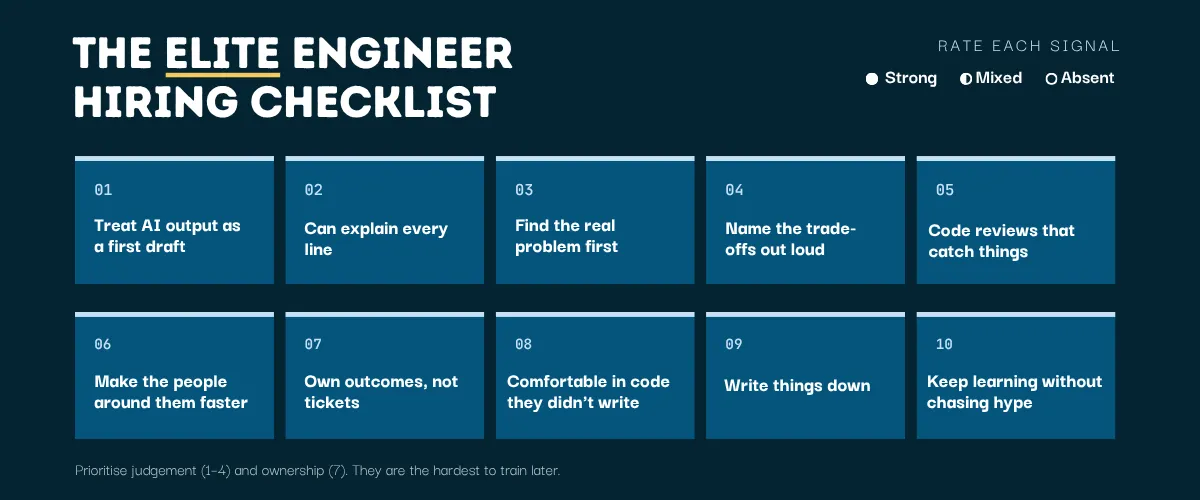
An easy way to do this is to rate each of the ten indicators as "strong," "mixed," or "absent" and ask each interviewer to write a single line of specific evidence next to each rating. A rating like "Seemed insightful" won't suffice; instead, a description such as "Identified the race condition within 4 minutes and explained how to reproduce it" is perfectly appropriate. You won't often receive ten strong ratings, nor should you expect to. What you are looking for is a clear pattern. Strong indicators regarding judgment (indicators 1 through 4) and taking responsibility (indicator 7): this is the combination that is hardest to remedy through subsequent training, so prioritise these aspects when it comes time to summarise the results.
Red flags that look like seniority but aren't
Some signals get mistaken for "Elite" all the time:
- Useful context, not evidence. Great teams carry average Engineers too. Big-name employers on the CV.
- Fast output with AI is now normal. Fast output that nobody has to fix later is rare. Speed alone.
- Breadth of tools matters less than depth of judgement. Knowing every framework.
- Anyone who says a design has no downsides hasn't looked closely. Confidence without trade-offs.
- Ten years can mean ten years of growth, or one year repeated ten times. Years of experience.
Traditional recruitment agencies often flood CTOs with profiles based solely on impressive brand names or years of experience. At TechPods, our shortlisting process filters out these fake seniority markers. We evaluate candidates against verified judgment, ownership, and code review capabilities, ensuring Company X interviews only genuine Elite Engineers.
Should you hire Elite Engineers or try to build them?
Ideally, both. Most of the 10 signals listed above are habits, which means they can be taught. However, coaching requires someone who already works this way, and most teams have at most 1 or 2 such Engineers.
That's why hiring for these signals matters so much. One Elite Engineer raises the review bar, sets the standards others copy and makes AI leverage compound across the team. It's also why the 10 developers or 3 Elite Engineers question has become a real one for CTOs this year, and why we believe teams should be sized around capability rather than capacity.
The hard part is finding them. Elite Engineers rarely apply to job postings, and the traditional hiring process, built around resumes and coding puzzles, often filters them out.
At TechPods, this checklist is close to how we vet the Bulgarian Engineers we build dedicated pods around. We test judgement, review quality and ownership, not just how fast someone can prompt a tool. Our Engineers join your standups, work in your codebase and share ownership of the outcome. That's what “Elite Systems. Elite Teams.” means in practice.
If you're about to open senior roles and want a second view on what "Elite" should mean for your team, talk to TechPods before the job spec goes out.
Frequently asked questions
What are the 10 qualities of an excellent Software Engineer?
Here is a practical list for hiring purposes: treats AI output as an initial draft; can explain every line of code they implement; identifies the core of the problem first; highlights potential trade-offs; conducts high-quality code reviews; helps others work faster; takes ownership of results; works effectively with existing code; documents decisions; and continues learning without getting distracted by passing trends (hype).
How do you evaluate a Senior Engineer in the age of AI?
Allow the use of AI during the interview and observe how the candidate evaluates the generated output. Combine a structured interview, a real-world coding task, and a live code review. Evaluate every candidate using the same criteria. What is the difference between a senior Engineer and an Elite Engineer? "Senior" is a title based on experience. "Elite" describes the way a person works: the quality of their decisions and their impact on the team. Many senior Engineers are not Elite, whereas some mid-level Engineers already operate at that level.
What are the red flags when hiring Software Engineers?
Excessive confidence without acknowledging trade-offs, shifting blame to others when describing failures, a lack of clarifying questions regarding ambiguous problems, and an inability to explain their own code. Having worked for a well-known company or possessing extensive professional experience is not a red flag in itself, but neither is it a guarantee of quality.