6 underrated senior Engineer skills that matter more in the AI era
- Business
- Tech

Most of the skills cited in current reports and blogs, or those sought by recruiters before the advent of powerful AI, are now outdated. Programmers today require a slightly different set of skills when AI is part of the equation. One of the most well-known legacy lists of skills, compiled by Camille Fournier, details what senior engineers need beyond mere coding. While it remains worth reviewing because it includes skills that will always be essential, it dates back to 2021, when writing code was the slow part of the process. Today, code generation is cheap and fast. The costly part is everything else: what is being built, what is being left out, and whether something written by an AI agent in four minutes is suitable for deployment in a real-world production environment.
Here are six skills that rarely appear in job descriptions but determine the actual value a senior engineer can derive from AI. For each skill, we outline what it looks like in a real team environment and how you can assess it before hiring a candidate.
What makes a senior engineer in the AI era?
As our CTO likes to say, it comes down to judgment and adaptability. These have always been more important than coding speed, and artificial intelligence has simply made that obvious.
When a tool can build the scaffolding of a service in minutes, the core of the work shifts away from the actual coding process. Even GitHub’s guidelines for developers now define quality execution as: clearly defining the problem, providing appropriate context, evaluating AI-generated code, and deciding what is ready for deployment. None of these four actions involves typing on a keyboard.
Experience also determines who benefits from this. A Fastly survey of 791 developers found that 32% of senior specialists (with over 10 years of experience) reported that more than half of the code they deployed was AI-generated, whereas for junior specialists, this figure was 13%. According to Fastly, the reason is that more experienced developers are better at spotting code that looks correct but actually isn't. At the same time, 28% of all respondents stated that they correct AI outputs so frequently that it negates most of the time saved. The six skills listed below are what set these two groups apart.
What are the most underrated senior engineer skills in the AI era?
Restraint is the most underrated skill in senior engineers
Restraint is one of the most important, yet least discussed, skills. We define it as the habit of avoiding the creation of unnecessary elements: not adding abstractions just because "we might need them later," not rewriting a functional module, and not accepting an extra 400 lines of code simply because they came "for free."
For a long time, the effort required to get the job done acted as a natural constraint. Creating a new microservice used to take days, so people would weigh whether it was worth it before starting. AI has removed most of these barriers. A single prompt now suffices for functionality that once required a week of persuasion, leaving the judgment of the person entering the prompt as the only remaining check.
This matters because generated code is not free. Someone must review every line, ensure security, keep the code operational, and explain it to the next new hire. A codebase that grows twice as fast as the product itself represents a cost that manifests later, usually at the most inconvenient moment.
On a team, restraint looks like this:
- Pull requests where more lines are deleted than added.
- The question "what happens if we just don't do this?" asked early, before anyone opens an editor.
- A preference for boring, proven tools over the clever new pattern an agent suggested.
- Pushing back on scope with a cheaper alternative, not just a no.
It rarely gets praised, because the best outcome of restraint is that nothing happens. No outage, no rewrite, no extra service to maintain.
Problem framing matters more when AI writes the code
AI excels at solving the problem described to it. However, this entails a significant risk, as the provided description, and consequently the resulting answer, may be flawed.
Consider, for instance, a task phrased as "make the payment process faster." A mid-level programmer or an AI agent would immediately begin optimising. A senior engineer, however, would ask: which specific step is slow? For which users? How was this measured? And what exactly does "faster" need to mean for the impact to be noticeable to the business? It often turns out that the real issue is a slow call to an external service or a confusing form field, things the generated code would never identify.
This is the essence of working with AI: clear constraints, known edge cases, and a precise definition of "done" transform the agent into a useful tool. Vague tasks, on the other hand, turn it into a means of rapidly creating something that fails to get the job done.
Reviewing AI-generated code
Senior Engineers read AI-generated code more critically than they'd read a colleague's. It tends to look clean and convincing even when it's wrong, and that's exactly what makes the mistakes easy to miss.
The data backs that up. When Veracode asked more than 100 large language models to write code in Java, Python, C#, and JavaScript, 45% of the samples failed security tests and introduced OWASP Top 10 vulnerabilities. The code worked. It just wasn't safe, and a green test suite wouldn't have told anyone.
A strong reviewer checks things the test suite can't:
- Does it do what was needed, or only what was asked? The prompt and the requirement aren't always the same.
- Does this logic already exist somewhere else? Agents happily write a second version of a helper the codebase already has.
- Are the tests testing anything? A test that only checks a mock returns what it was told to return will pass forever.
- What did it assume? Time zones, currencies, null values and retries are where plausible code quietly breaks.
We go deeper into how this fits into the wider workflow and how Elite Engineers orchestrate AI instead of just using it.
System knowledge matters more when AI can write any function
The AI tool sees its context window, but the senior engineer sees the system.
They know why that odd retry loop exists (due to a payment service provider whose connection drops during the month-end close), which internal API three other teams depend on, and which "temporary" workaround is currently slowing down the report generation process. None of this is contained in the file the agent is editing. A piece of code might be correct in isolation yet wrong for the system, and only someone who sees the big picture would notice that.
This kind of knowledge builds up slowly and lives in people. It's one reason a stable core team beats a rotating cast of contractors, and part of why adding more Engineers doesn't always mean faster delivery.
Clear writing is now a senior engineering skill
What a senior Engineer writes down now has two readers: the team and the AI tools the team works with.
A brief design document, an architectural decision record, or a conventions file in the repository are resources that help onboard new members. Today, these same files shape the output the agent produces whenever it is prompted. Teams with clear written conventions achieve noticeably more consistent results, whereas teams that keep everything in people's heads end up with code that ignores half their rules.
Senior Engineers who write well tend to create:
- Decision records that explain the "why," not just the "what."
- Conventions and guardrails that both humans and agents can follow.
- Pull request descriptions that a reviewer can check in five minutes.
- Plain-language summaries of trade-offs for non-Engineers.
It isn't glamorous work. But it saves hours of review time every week.
Knowing when not to use AI
This happens more often than the hype surrounding the technology suggests. Knowing when to put the tool aside is a valuable skill in itself.
Skilled senior engineers often set the tool aside when working on security-critical code, when they need to understand an unfamiliar part of the system truly, or when debugging requires deep analysis rather than just another batch of suggestions. They also recognise when they have wasted twenty minutes fine-tuning a prompt for a task they could have completed manually in ten.
Why is this so easy to miss? A Microsoft Research study of 319 knowledge workers, presented at CHI 2025, found that higher confidence in GenAI went with less critical thinking, while higher self-confidence went with more. Put simply, the more someone trusts the tool, the less they tend to check it.
None of this is anti-AI. It's the same judgement as picking the right library or the right database, applied to a new kind of tool, and it's a big part of why the same AI tool gives very different results in different hands.
How can CTOs test for these skills when hiring senior engineers?
Most technical interviews still measure how quickly someone writes correct code from scratch.
That was a reasonable proxy in 2019. In 2026 a better approach is to recreate the moments where these skills show. Here's what we'd ask, and what a strong answer usually sounds like.
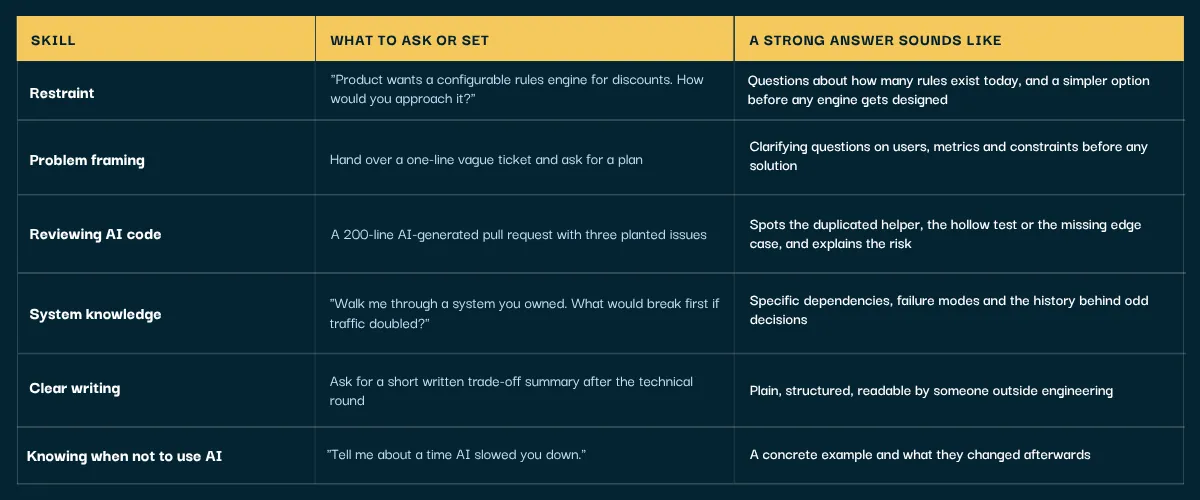 For the rest of the vetting picture, our 10-point hiring checklist for CTOs covers it.
Two practical notes. Let candidates use AI during the exercise, because you're hiring for how they work, not how they'd work in 2019. And pay attention to the questions they ask you. Senior Engineers with good judgement nearly always ask more than they're asked.
Are senior engineer skills more valuable because of AI?
Yes. AI does not erase the difference between a good senior Engineer and an average one, it widens the gap, as every decision is now amplified by the volume of code a tool can generate based on it. We've seen the same pattern from other angles: AI reveals which Engineers are elite rather than replacing them, and it won't fix a weak engineering team either.
That's the thinking behind Elite Systems. Elite Teams. We look for these exact traits when we vet Engineers for our dedicated teams, alongside the technical depth you'd expect. The people we place join your standups, work in your codebase and share ownership of what gets built, so the restraint and judgement stay inside your team rather than sitting with a vendor on the side. If you're weighing ten developers against three Elite Engineers, or restructuring your engineering team around AI, these six skills are usually what tips the decision.
Hiring senior Engineers for an AI-heavy roadmap? Talk to us about finding the ones who know what not to build.
Frequently asked questions
What is the most underrated skill in a Senior Engineer?
Restraint. Choosing not to build something, or to build less of it, prevents more problems than almost any other habit. With AI tools making code nearly free to produce, it has become one of the clearest signs of real seniority.
What skills do software engineers need in the age of AI?
Beyond solid technical foundations: framing problems clearly, reviewing AI-generated code critically, understanding the wider system, writing clear decisions and conventions, and knowing when not to use AI at all.
Will AI replace senior software engineers?
Not on current evidence. AI speeds up writing code, but research from Veracode and Fastly points the same way: someone still has to judge whether the output is safe, correct and worth shipping. That judgement is exactly what senior Engineers provide.