The 2026 CTO's guide to restructuring engineering teams around AI: 7 moves that actually work

- Business
- Tech

If you compare your engineering team’s organisational chart from 2022 with the current one, you will likely find many similarities—such as the same teams, the same frontend, backend, and QA units, and roughly the same ratio of junior to senior specialists. However, there is a tangible difference, or rather, a shift: every engineer now has access to an AI-powered coding tool, with the licensing costs quietly tucked away in a separate budget line item.
This is precisely the root of much of the frustration CTOs feel regarding artificial intelligence. These tools have transformed the volume of work an engineer can accomplish in a week, yet the organisational structure in which they operate has remained completely unchanged, or has begun to evolve only very slowly.
Most of the talk about AI in engineering so far has been about people: why some Engineers get far more out of the same tool than others, and why certain teams end up worse off after adopting it. Both questions are useful. However, the "boxes" and lines where people are positioned rarely receive the same level of attention, and this is precisely where this guide steps in, presenting seven structural changes arranged according to how we would approach them if the 2027 workforce plan had to be ready by this coming Monday.
What does restructuring an engineering team around AI actually mean?
Simply put, team structuring begins by shifting the workflow, realigning it with the accelerated pace of AI-driven code generation rather than adhering to where the work used to take place.
The reality is that the nature of the work is indeed shifting. As coding accelerates, the code review process becomes more demanding due to the increased volume. Consequently, testing and deployment face greater strain because each cycle involves more changes; meanwhile, decision-making intensifies, as someone must evaluate what is worth developing and verify the accuracy of the AI-generated output.
Most teams in 2022 still direct the bulk of their human resources toward writing code. However, this failure to adapt will sooner or later have negative consequences. A team structured around AI utilisation invests more effort in evaluating the various aspects surrounding the code itself, and the steps outlined below are essentially ways to achieve this operational model.
Will AI reduce the size of your engineering team?
Sometimes. It's still the wrong question to start with.
The evidence doesn't back the idea that AI automatically makes every team smaller and faster. DORA's 2025 State of AI-assisted Software Development report found that 90% of respondents use AI at work, and for the first time, AI adoption was linked to higher delivery throughput, but it was also still linked to lower delivery stability, which is what you'd expect when more change runs through the same safety nets as before.
Individual speed can be misleading as well. In a randomised study by METR, experienced open-source developers took 19% longer to finish tasks when they used AI tools. Afterwards, they believed AI had made them about 20% faster.
So yes, some teams will get smaller. The CTO who cuts headcount first and restructures later, though, tends to end up with fewer people stuck inside exactly the same bottlenecks, which is why we'd fix the shape before touching the size (the sizing side is covered in our capacity vs capability framework).
7 moves for restructuring engineering teams around AI leverage
1. Organise teams around product domains, not job functions
Everything else hinges on this, so start here.
According to Conway's Law, your system eventually comes to reflect your organizational structure. If you separate your backend, frontend, data, and QA teams, you will end up with a fragmented product involving multiple handoffs between teams; if you add AI agents to the mix, it becomes unclear who is responsible for the agent's output, who reviews it, and who gets notified when a problem arises.
LeadDev's guide to building teams in the AI era argues for the "reverse Conway" approach. Decide first how the product should work. Then shape the teams around product domains such as billing, onboarding or payments, so that each one owns a domain end to end with clear interfaces and a clear definition of done, and AI tools get a bounded space to work in with far less context to juggle.
In practice, that usually means small cross-functional teams, each owning an outcome instead of a layer of the stack.
2. Rebalance seniority, but don't cut off the junior pipeline
Senior-weighted teams have become far more productive with AI, and that part isn't hype. We've argued before that for some kinds of work, three Elite Engineers can now out-deliver ten average ones.
Where CTOs get into trouble is going too far. A World Economic Forum piece drawing on the Dev Barometer Q2 2026 survey of more than 1,500 developers found that 54% of senior developers agree AI is making the junior role less relevant. The same article describes a less obvious problem that can easily go unnoticed when tracking metrics. It posits a scenario where a senior specialist takes on a task that would once have served to train a junior colleague; they complete it faster with the help of artificial intelligence, the sprint appears to be on track, yet no one on the team has learned anything new. Results remain stable, even as the foundations of the process are being undermined.
It is worth noting here that we are not downplaying the value of junior developers or suggesting they are unnecessary, quite the opposite. Retain some of these positions, perhaps fewer in number, but with redefined roles. This way, entry-level employees can spend their time reviewing AI-generated output, writing tests, gaining domain knowledge, and participating in architectural decisions, rather than producing initial drafts that an AI agent could generate in seconds.
3. Treat code review as a role, not a side task
In most teams, code review is something senior engineers squeeze in between their "actual" work. This approach was viable when code arrived at the pace at which people work.
It isn't any more. CodeRabbit's December 2025 analysis of 470 open-source pull requests found that AI-co-authored PRs had around 1.7 times more issues than human-only ones, with security issues up to 2.74 times more common, and all of that extra code with extra issues per change lands on the same handful of reviewers you had before.
Therefore, plan code reviews intentionally:
- Allocate time for reviews during sprint planning, just as you do for development.
- Keep pull requests small enough to be realistically readable.
- Ensure that every team responsible for a specific area includes at least one engineer with the judgment to say "no" to code that appears correct at first glance.
- Schedule review checkpoints during the planning stage, rather than only at the time of code merging.
This is the practical side of how Elite Engineers orchestrate AI instead of just using it, where review stops being a queue at the end and becomes part of how the work is designed in the first place.
4. Give platform engineering a real team
Weak internal tooling becomes costly once AI enters the mix. Slow pipelines, flaky tests, and manual deployments used to be mere annoyances; now, they set a ceiling on the output of your AI tools.
DORA found that 90% of organisations have adopted at least one internal platform, and the quality of that platform directly correlates with the value teams derive from AI. View this as a matter of organisational design. Someone must own the "paved road"—encompassing CI/CD, test infrastructure, environments, AI tool configuration, shared prompts, and guardrails, as well as the internal documentation agents rely on for context.
In a smaller company, this might be a two-person job. In a larger one, it calls for a dedicated platform team; regardless, it should not simply become leftover work for whoever happens to be least busy that week.
5. Write down what AI owns and what humans own
Is it obvious? Yes. Yet hardly anyone does it.
Without a clear boundary, you might find one engineer deploying AI-generated code almost exactly as is, while the colleague next to them rewrites everything by hand—with both convinced they are doing the right thing. A simpler framework for assigning responsibilities across specific areas solves most of these problems:
- AI can do it, a human reviews it: scaffolding, boilerplate, test generation, documentation drafts, simple refactors.
- AI can assist, a human decides: API design, data models, performance-sensitive code.
- Human only: architecture trade-offs, security-critical paths, payments, anything with legal or customer consequences.
The map will shift as the tools improve, and that's fine, as long as the team has agreed on it and a tech lead owns keeping it current.
6. Change your metrics before you change the org chart
If you measure output, AI will readily provide it: more PRs, more commits, more closed tickets, but none of this proves that the restructuring was successful.
Instead, measure the system itself. Before and after every structural change, track:
- Lead time from first commit to production.
- Change failure rate and time to restore service.
- PR review time and PR size.
- Rework, meaning how much recently shipped code gets rewritten within a few weeks.
- Bus factor on your critical services.
If throughput increases but stability drops, the new structure is not yet functioning as it should; it simply needs time. Most teams experience a temporary dip while mastering new ways of working. However, viewing this dip as a failure is one of the most common reasons why sound reorganisations are scrapped before they have a chance to yield results.
7. Build a small core and flex the edges
The final step concerns where your people come from.
The most resilient organisational structure we observe in the era of artificial intelligence features a small, stable core of elite engineers. They are responsible for architecture, code reviews, and domain expertise, while additional capacity is brought in where work can actually be performed in parallel. Core stability is crucial, as this is where the organization's accumulated knowledge resides, whereas the periphery can adapt flexibly to the project roadmap.
Filling that core with short-term contractors, or with a vendor working tickets from the outside, is the mistake to avoid, because when they leave, the knowledge leaves with them. It's also a big part of why adding more Engineers doesn't always mean faster delivery: people who don't share ownership add coordination cost, not speed.
What does an AI-leveraged engineering team look like in practice?
Here's a simplified before-and-after for a scale-up with around 20 Engineers.
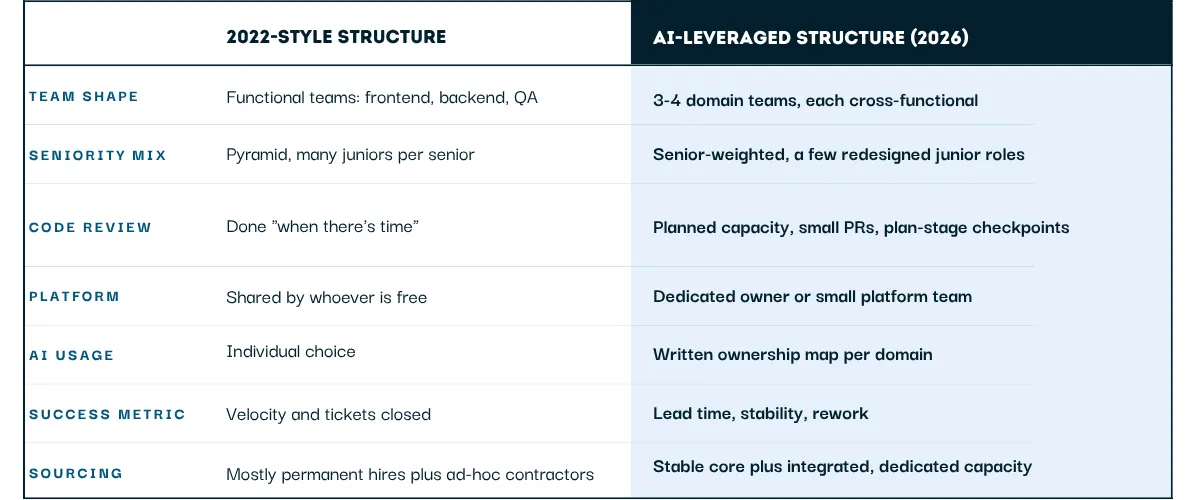 Headcount might stay at 20, or it might fall to 15. The bigger change is where those people spend their judgement.
What mistakes do CTOs make when restructuring for AI?
A few come up again and again:
- Cutting first, redesigning later. You keep the bottlenecks and lose the people who knew how to work around them.
- Buying more AI seats instead of more review capacity. Generation stopped being the constraint a while ago.
- Removing every junior role. It saves money this year and costs you a senior hire in 2028.
- Reorganising without new metrics. Without a baseline, nobody can tell whether the change worked.
- Keeping ownership outside the building. Outsourced teams working from tickets can't hold the domain knowledge AI depends on.
Where should CTOs start?
Start with a single area. Select the team with the most clearly defined product boundaries, map out its AI-related responsibilities, ensure it has the capacity for reviews, and track the results over the course of a full quarter. You will learn more this way than from any large-scale reorganisation announced at a company-wide meeting.
Next, carefully analyse the individuals holding key positions within the core team. For most CTOs we speak with, this is precisely where the real constraint lies: there is simply a lack of engineers possessing the judgment required to conduct reviews, make decisions, and assume full responsibility for a given area.
Closing that gap is what TechPods is built for. Through Elite Systems. Elite Teams., we build dedicated teams of Bulgarian Elite Engineers who join your standups, work in your codebase and share ownership of the system rather than just the backlog, so they become part of your core instead of a vendor on the side.
Redrawing your engineering structure for 2027? Talk to TechPods before the new organisational chart goes to the board.
Frequently asked questions
How should you structure an engineering team for AI?
Organise small, cross-functional teams around product domains, weight them towards senior Engineers, plan review capacity explicitly, give platform engineering a clear owner, and agree in writing which work AI can own and which stays with humans.
Will AI reduce the number of developers a company needs?
For some teams, yes, but not automatically. DORA's 2025 research links AI to higher throughput and also to lower stability, so teams that cut headcount before fixing review, testing and ownership often end up slower rather than leaner.
What is the right senior-to-junior ratio in an AI-native engineering team?
There's no single number. Most AI-leveraged teams are more senior-weighted than before, but keeping a smaller number of junior roles, redesigned around review, testing and domain learning, protects your pipeline of future senior Engineers.