Dedicated vs Shared Developers: Why Full Attention Changes Outcomes
- Co-sourcing
- Business

Half a developer is not half a developer.
It sounds obvious when you say it out loud. Yet it's one of the most common assumptions in engineering resourcing, and it hides inside spreadsheets everywhere: one Engineer, two projects, 50% allocation each. The maths looks neat. The delivery rarely does.
In discussions we hold with CTOs, this often arises after an issue has already occurred. A vendor's "dedicated" developer is actually working on three different accounts. An internal lead gets lent to another team "just for a couple of sprints". A senior Engineer splits the week between building the new platform and firefighting the old one. Each time, the plan said capacity was there. Each time, the outcomes said otherwise.
Below, we look at what the research says about split attention, why it costs more than the timesheet shows, and when dedicated developers make the bigger difference.
What is a dedicated developer?
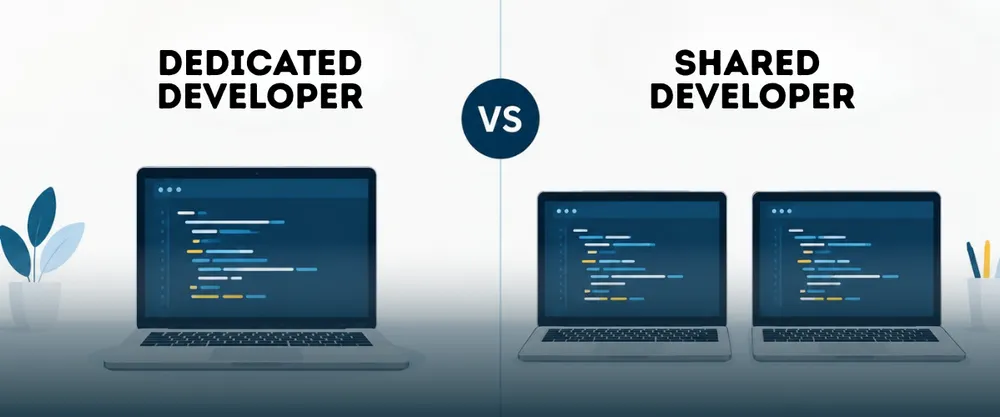
We define “a dedicated developer” as someone who works on one product or client, full-time. Their attention, context and working hours belong to a single codebase and a single team.
On the other hand, a shared (or split-focus) developer divides their week between several projects, clients or teams. It’s a typical setup in traditional outsourcing, where one developer is often spread across several client accounts. Sometimes that’s planned, as in a 50/50 allocation. Often it isn’t. The developer is nominally on your project but gets pulled into another client’s incident, a pre-sales call or someone else’s backlog.
The difference matters less in the job description and more in what happens between 9 am and 6 pm, specifically in how many times a developer must shift from one mental framework to another.
What does context switching actually cost developers?
More than most managers budget for. Three bodies of research point in the same direction.
Each additional project takes a bigger slice than you expect
In Quality Software Management: Systems Thinking, Gerald Weinberg set out a rule of thumb for the waste caused by switching between projects. As Carnegie Mellon's Software Engineering Institute summarises it, someone working on two projects gets about 40% of their time on each, with roughly 20% lost to switching. With five projects, each one receives less than 10%, and around 80% of the week disappears into changing context.
Weinberg referred to it as a heuristic, rather than a laboratory finding. Nonetheless, it corresponds with what cognitive psychologists have assessed. The American Psychological Association's summary of multitasking studies explains experiments conducted by Rubinstein, Meyer, and Evans, revealing that individuals took longer when alternating between complicated or unfamiliar tasks. David Meyer suggests that these cognitive barriers can result in a loss of as much as 40% of an individual's productive time.
Software development is among the most intricate and unfamiliar aspects of everyday work. Each codebase possesses its unique architecture, naming standards, business regulations, and a record of choices that remain undocumented.
Software Engineer Ben Northrop calls the 50/50 assumption the fallacy of splitting time. Every project has its own overhead (standups, planning, Slack conversations, updating on changes), and a divided developer incurs that overhead two times before coding. He determines that both projects receive under 50%, likely much lower.
Developers don't resume where they left off
Chris Parnin and Spencer Rugaber analysed close to 10,000 recorded programming sessions from 85 programmers to see what happens when developers return to interrupted work. Just 10% of sessions initiated coding activities in less than a minute. In roughly 30% of sessions, the delay before the initial edit exceeded 30 minutes. Developers utilised that time to reconstruct context: exploring files, revisiting code, figuring out their previous locations.
Imagine a developer alternating between two clients several times each day. A significant portion of every return involves recollection rather than creation.
Attention residue: the part of your brain that stays behind
Organisational researcher Sophie Leroy gave this effect a name. In her 2009 paper, Why is it so hard to do my work?, she showed that when people switch away from an unfinished task, part of their attention stays with it. She called this "attention residue". Performance on the next task suffers as a result.
That perfectly characterises the split-focus developer. Their tasks are seldom complete when they change. The issue in Client A's payment process is still partially diagnosed when Client B's standup begins, so the remnants carry over to the meeting and the following pull request.
Faster isn't the same as better
There's a twist worth knowing about. Gloria Mark and colleagues at UC Irvine found, in The Cost of Interrupted Work: More Speed and Stress, that interrupted people actually finished tasks faster, with no difference in quality on the email tasks they studied. The price showed up elsewhere: significantly higher stress, frustration, effort and time pressure.
In engineering terms, a split-focus developer can look productive in the short run by compensating. Over months, that compensation turns into fatigue, shortcuts and, eventually, turnover. And once people leave, the cohesion your team relies on goes with them.
Why are developers split across multiple projects in the first place?
Seldom do people think it's the most effective approach to develop software. Typically, it boils down to one of three factors:
- Utilisation targets: Some vendors staff Engineers across several accounts to keep everyone billable. The rate card looks the same, but the attention behind it is divided.
- Scarce senior skills: The one person who understands the legacy system gets shared between the team maintaining it and the team replacing it.
- Short-term thinking: Lending an Engineer "for a few weeks" looks cheaper than finding the right person for the job.
None of these shows up as a line item. They show up as slower cycle times, longer review queues and a roadmap that keeps slipping by a sprint, which is one reason adding more Engineers doesn't always mean faster delivery. Headcount on paper and attention in practice are two different numbers.
Dedicated vs shared developers: how outcomes differ
The disparity extends beyond time. This is how it generally unfolds regarding the aspects that CTOs genuinely prioritise.
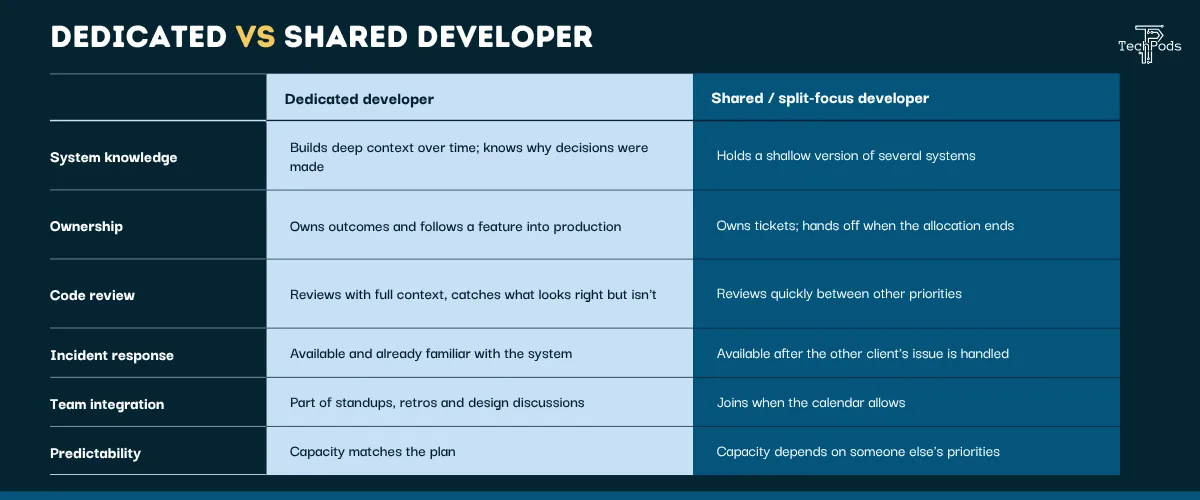 Code review deserves special attention in 2026. With AI tools producing more code than ever, the bottleneck has moved to the judgement needed to review it. Judgement depends on context, and context is exactly what a split-focus developer never gets enough time to build. Atlassian's 2026 State of Developer Experience report found that 72% of developers report the same or more friction than before AI, and it ranks context switching among the top sources of it. AI speeds up writing code. It doesn't fix divided attention.
Is a dedicated developer worth it for short-term projects?
Certainly, and arguably to a greater extent. A brief project has limited time to process waste. If a six-week project experiences a 20% loss of its developer's focus due to switching, that's over a week lost, leaving little time to recover.
Committed doesn't need to imply everlasting. It signifies complete focus lasting throughout the duration of the project, whether it's a three-month MVP, a migration, or a multi-year product. The model is capable of flexibility. The emphasis shouldn't be on it.
There are scenarios where sharing functions effectively: a steady system requiring infrequent minor adjustments, or an expert hired for a specifically limited evaluation. Even so, it's beneficial to organise that work into full-day blocks instead of dividing each day in two.
How do the best teams protect developer focus?
Some of the most respected product companies treat uninterrupted time as part of the design rather than a perk.
Basecamp's Shape Up approach dedicates a team to a project for a six-week period and clearly defines what this entails: the team remains focused and is not diverted or assigned to other tasks. Their logic is straightforward: "Missing the right hour can ruin a day. "Losing one day can ruin an entire week." If something new arises, it holds off until the next cycle unless it's a true emergency.
The Team Topologies framework, outlined by Martin Fowler, addresses the same issue by focusing on cognitive load. Stream-aligned teams manage a product area from start to finish, with much of the model designed to lessen the burden on these teams, allowing them to concentrate on business results. Distributing individuals across multiple streams directly contradicts that.
The practical lessons for engineering leaders:
- Allocate people to products, not percentages. If you find yourself writing "0.5 FTE", ask what the other 0.5 is costing.
- Protect blocks of time. Batch meetings, keep afternoons free and route ad hoc requests through one person.
- Finish before switching. Leroy's research suggests finishing a task, ideally under a clear deadline, before moving on reduces residue.
- Ask your partners directly. "Is this Engineer working on any other client?" should have a one-word answer.
How can you tell if your developers are split-focus?
Not every split is visible on an org chart. These questions usually reveal it:
- Do your external developers ever say "I'll look at it after my other call"?
- Can you name every project each of your Engineers is working on this week?
- Has a "dedicated" developer been unavailable during an incident because of another commitment?
- Do code reviews from certain people consistently arrive late or lack depth?
- Does your vendor's contract guarantee exclusivity, or only several hours?
If two or more of those land uncomfortably close to home, attention is probably your real constraint, not headcount. Our capacity vs capability framework is a good next step for working out which one you're short of.
How we build dedicated teams at TechPods
Complete focus is essential for us, and it influences every aspect of our operations.
Each Engineer we assign collaborates with a single partner at a time. They don't switch between clients and aren't held in reserve to be utilised. Via our co-sourcing model, they participate in your standups, operate within your codebase, utilise your tools, and share system ownership with your internal team.
That is relevant no matter the duration. For targeted, brief objectives, our Mission Pods assemble a compact cross-functional team from AI, product engineering, mobile, data, cloud, or QA, entirely dedicated to one mission until it is accomplished. To ensure sustainable growth, the same Engineers continue working with you and maintain context from one quarter to another.
This is also the reason we prioritise smaller teams of top Engineers instead of larger workforces. Typically, three committed Engineers with in-depth knowledge will outperform five who are only contributing a portion of their time. If your timeline continues to shift even with a "fully staffed" team, consider how dedicated focus might make a difference. Let’s talk.
Frequently asked questions
What is the difference between a dedicated and a shared developer?
A dedicated developer works full time on one product or client, so their attention, context and working hours belong to a single codebase and team. A shared developer splits their week across several projects or clients. That means repeatedly switching mental models, paying each project's overhead separately and building only shallow knowledge of each system.
How much productivity is lost to context switching?
More than most plans assume. Gerald Weinberg estimated that a developer on two projects gives each about 40% of their time, losing around 20% to switching. With five projects, each gets less than 10%. Psychologist David Meyer estimates that task-switching can cost up to 40% of someone's productive time.
Is it better for developers to work on one project at a time?
In most cases, yes. Research on interrupted programming shows developers rarely resume coding straight away, and switching away from unfinished work leaves "attention residue" that hurts performance on the next task. Sharing can work for small, stable maintenance work, ideally grouped into whole days rather than split within each day.