
Nearly every engineering leader has experienced at least one outsourcing project that seemed solid on paper but turned out badly in reality. So when "forward deployed engineering" began showing up in board presentations and vendor proposals this year, a valid question arose: is this merely outsourcing under a different label?
It isn't. In many ways it's the opposite. But the two get mixed up because both involve Engineers who aren't on your original team, and because plenty of suppliers now use "FDE" and "dedicated team" quite loosely. This article compares forward-deployed engineering, outsourcing and dedicated teams side by side, explains where co-sourcing fits, and helps you work out which model suits the problem in front of you.
If you'd like a primer on the role itself first, start with what a forward deployed engineer actually is.
Why are CTOs comparing these models now?
Because forward-deployed engineering is now being sold as a delivery strategy by the largest IT companies, which alters the dialogue for everyone else.
In June 2026, AWS introduced a specialised forward-deployed engineering division supported by a $1 billion investment. By October it had opened FDE pathways and credentials for its partners, so customers can now choose between AWS's own FDEs, AWS-led engagements with partner specialists, or fully partner-led FDE delivery. A Forbes Technology Council piece by Rex Lee, EVP and Chief Information and Technology Officer at Canadian Tire, lists similar moves from Accenture with Microsoft and from Tata Consultancy Services, which plans an FDE workforce of several thousand people.
When the biggest vendors and consulting firms all begin to offer the same thing, it's natural for CTOs to ask how it differs from what they already purchase. This article answers that question.
What is the forward-deployed engineering model?
In the forward deployed engineering model, Engineers work inside the business, alongside the teams who will actually use what they build. They help define what needs building, build it against real systems and data, and stay involved until it's working in production and being used.
Three features set the model apart:
- Proximity: The Engineers sit close to users and decision-makers, not behind an account manager or a ticket queue.
- Ownership: They're accountable for outcomes, not just for delivering what was specified.
- Continuity: They don't hand over at launch and disappear. They stay until adoption is real.
We cover the role in more depth in our guide to FDE vs solutions engineer, solutions architect and consultant. For this comparison, those three features are what matter.
How is forward deployed engineering different from outsourcing?
Outsourcing shifts tasks away from your company. Forward-deployed engineering involves incorporating Engineers into it. That distinction appears in three areas.
Who owns the problem
In a standard outsourcing agreement, you specify the scope and the vendor delivers according to it. If the scope turned out to be incorrect, that is typically your responsibility, and correcting it turns into a change request. The vendor is paid to build what was agreed upon, not to ask whether it was the right thing to do.
An FDE is expected to question it. Part of the job is spotting when a request doesn't match the real need and saying so before anyone writes code.
Where the context lives
Typically, tickets and documentation are used by outsourced engineers. They don't often interact with the users of the system, therefore the knowledge they develop is limited and mostly resides within the vendor rather than your team. We've written about how that plays out in 7 outsourcing myths costing UK tech leaders talent and time.
FDEs build context by being in the room. They see the workarounds, the undocumented rules and the reasons behind decisions, and that knowledge goes straight into what they build.
What happens after launch
An outsourcing project generally concludes upon delivery. The code is transferred, the team progresses to the next client, and anyone taking over the system must understand it from the beginning.
Forward deployed engineering treats launch as a midpoint. Adoption problems, edge cases and the first real feedback all arrive after go-live, and the Engineers who built the system are still there to deal with them.
FDE vs a dedicated development team
This comparison is not as straightforward, since "dedicated team" varies in meaning based on the seller.
A dedicated team is essentially a group of engineers who work only on your project, typically for a long time. One of the main issues with outsourcing, which is developers divided among multiple clients, is already resolved by that. Full attention matters more than most resourcing plans assume, as we explain in dedicated vs shared developers.
However, a dedicated team does not guarantee how the Engineers actually work. Certain vendors provide a dedicated team yet manage it on their own, through their own project manager, leaving your business on the far side of a reporting layer. In practice, that's outsourcing with a fixed headcount. Other dedicated teams join your standups, use your tools and talk directly to your stakeholders. That's much closer to the FDE model.
So the useful question isn't "dedicated or not?" It's whether the team has the proximity, ownership and continuity described above.
Vendor FDEs vs your own: does it matter whose Engineers they are?
More than you might expect.
The purpose of the FDEs that a software provider gives to your company is to enable you to use their product. That is worthwhile. However, as Rex Lee contends in his Forbes article, internal FDEs improve the company itself, but vendor FDEs eventually incorporate what they learn back into the vendor's product. The knowledge, the reusable code and the understanding of how your business works either build up inside your company or leave with the vendor's team.
That's why the question of who the Engineers work for is just as important as where they sit.
Where does co-sourcing fit in?
Co-sourcing sits between building an in-house FDE team and buying a vendor's.
In a co-sourced model, Engineers work only for you, inside your team and under your day-to-day direction, while a partner handles recruitment, employment and retention. They are not linked to a specific software provider's product, nor are they managing your project remotely. The understanding they develop remains within your codebase and your team.
They are not linked to a specific software provider's product, nor are they managing your project remotely. The understanding they develop remains within your codebase and your team. Barry McCardel, who spent five years in a forward-deployed role at Palantir before founding Hex, warns in an essay on FDE culture that doing it properly needs a very high hiring bar and a generous budget, and that most companies copying the title end up with a renamed sales engineering team instead. Co-sourcing provides you with engineers capable of working the FDE way, so you don't have to build that entire organisation from scratch yourself.
For more on how co-sourcing differs from outsourcing in general, see co-sourcing, not outsourcing.
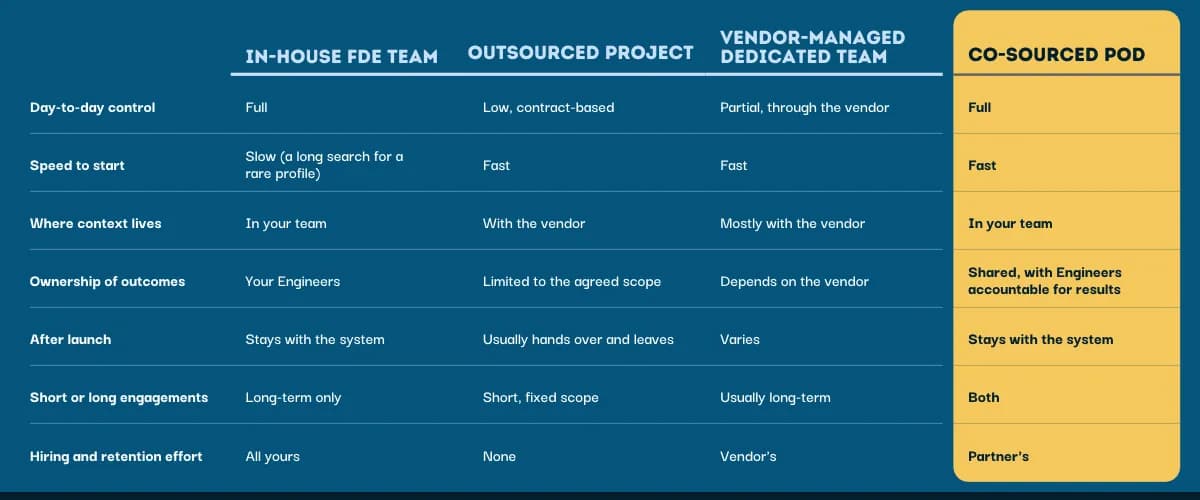 No column wins on every row. The right choice depends on the problem you're solving and how much of the work needs to stay inside your business.
Can an embedded team work like forward deployed engineers?
Yes, provided the circumstances are right. Simply adding Engineers to your Slack channels and standups won't be sufficient by itself. Being nearby without any authority only leaves you with a team that's more connected to the tickets.
An embedded team works the FDE way when it has:
- Direct access to stakeholders: The Engineers can talk to the people with the problem, not only to whoever writes the tickets.
- Permission to challenge: They're expected to question a requirement that doesn't match the need, and someone listens when they do.
- Accountability after launch: Their success is measured by whether the solution is used and works, not by whether it shipped.
- Continuity: The same people stay with the work long enough to learn the business, whether that's a three-month project or a multi-year product.
We go into this distinction further in FDE vs FTE, where the point is that headcount on its own tells you nothing about ownership.
Which model fits your situation?
A few rules of thumb:
- The work is fixed in scope, self-contained and nobody will maintain it afterwards. A traditional outsourced project can be fine here: a one-off migration, a marketing microsite, a throwaway prototype.
- You're adopting a specific vendor's platform and need it configured well. The vendor's own FDEs or certified partners make sense, as long as you plan how the knowledge will stay with you afterwards.
- You have the budget, time and hiring power to build a permanent FDE function. An in-house team gives you maximum control, if you can find and keep the people.
- You need FDE-style ownership now, for core product work or a stalled AI project, without a long hiring cycle. A co-sourced pod embedded in your team is usually the fastest route.
Numerous firms ultimately merge models. What is important is to be explicit about who possesses the outcome in each case.
How our pods apply the FDE model
We built TechPods around the same ideas that make forward deployed engineering work, long before the title became popular.
Our Engineers work for one client at a time. They join our clients' teams directly, take part in planning and standups, and talk to the people who'll use what they build. Through our co-sourcing model, the client keeps control of the roadmap, the knowledge stays in their team, and we take care of hiring, employment and retention.
That is effective for continuous product development, and it is equally suitable for particular issues, like an AI integration that has halted at the pilot phase, requiring Engineers to advance it to production and remain until it is in use. If you're weighing up which model fits your next project, talk to us.