7 outsourcing myths costing UK tech leaders talent and time


If you ask a CTO about outsourcing, most probably you will end up listening to a story. In most cases, the stories will be, if not identical, at least similar. One can be that the vendor swapped out their best developer in the middle of the project, or the contract ended, and the codebase is not understandable to anyone in-house. Another common one is that the invoice kept growing every time the scope of the project moved an inch.
All of those stories are true. We communicate with CTOs on a daily basis, and we don't think the people telling them are being unfair.
Where it goes wrong is the conclusion most people draw: that these problems are simply what you get when Engineers sit outside your payroll. So the senior role stays open, the roadmap slips, and the team carries the gap for another quarter. That conclusion is the myth, and it's an expensive one.
Here are the seven outsourcing problems we hear about most from the CTOs we speak with. Let’s analyse why they happen, and how a co-sourcing model removes each of them.
What is the downside of outsourcing software development?
Most of the drawbacks stem from a specific decision regarding how the work is organised. In traditional outsourcing, the team belongs to the service provider.
The provider hires the programmers, manages them, decides which client project each person works on during a given month, and retains the knowledge of how your product functions. In effect, you are purchasing the final result. Every problem discussed in this article is rooted in this very model: you cannot control people you do not manage directly; you cannot retain knowledge held by an external company; and you cannot build loyalty within a team that is loyal to the service provider.
It's also why the market is shifting. Deloitte's 2024 Global Outsourcing Survey of more than 500 executives names skilled talent and agility alongside cost reduction as the main reasons companies look outside, which is a very different brief from "build this cheaper." Getting talent and agility from a model built around handing work over is hard. It's much easier when the external Engineers are part of your team.
7 outsourcing myths UK tech leaders still believe
Myth 1: "The day rate is what outsourcing really costs"
The majority of the CTOs come to us and start comparing the rate card, but actually, in outsourcing, the number you end up paying is different. The hidden costs always pile up somewhere else. Developers rotate, so every new face needs weeks to learn your codebase. Rework grows because the people writing the code don't own it after release. Change requests get repriced. Margins sit inside bundled fees, so you never quite know what you're paying for.
Co-sourcing works the other way round. You pay a transparent, predictable monthly cost for named Engineers who stay with your product, and the time you'd spend re-onboarding new developers goes back into delivery. Looking for a cheaper rate isn't the point. What you're after is a lower total cost once rotation and rework are counted, which is the case we make in the benefits of a co-sourcing strategy.
Myth 2: "Losing control is the price of using external Engineers"
In outsourcing, you do lose control. That part isn't a myth.
This is because the vendor manages the people, assigns the work and can decide to move a strong developer to a bigger client whenever it suits them. Often you find out afterwards. It's the core problem with the bench model in IT outsourcing, where developers are a pool to be shuffled rather than a team to be built.
The myth is that control and external Engineers can't go together. In a co-sourced team, the Engineers join your standups, work in your repositories, follow your review rules and take their priorities from your engineering leads. You choose who joins, and you manage the day-to-day. We handle recruitment, payroll, equipment and retention- the parts of hiring that take up a CTO's week without moving the product forward.
Myth 3: "It's either a slow UK hire or handing the work to a vendor"
Many UK tech leaders see only two options. Wait for the right local hire, or outsource and accept the problems above.
The local route is slow for reasons outside your control. ManpowerGroup's UK Talent Shortage 2026 report found 73% of UK employers are struggling to fill roles, barely down from 76% a year earlier. Skills England's Sector Skills Needs Assessment for digital and technologies, published in August 2026, puts programmers and software development professionals at the top of projected demand, with 69,000 additional workers needed between 2025 and 2035. And according to Nash Squared's 2025 Digital Leadership Report, 52% of the 924 UK tech leaders surveyed were dealing with an AI skills shortage, up from 20% the year before.
Contractors don't really solve it either. Since April 2021, medium and large private sector clients have been responsible for deciding whether a contractor falls inside off-payroll working rules (IR35), and a contractor-heavy core team still walks out the door when the contracts end.
Co-sourcing is the third option. You get dedicated Engineers, vetted against your bar, who work as part of your team for the long term, usually within weeks rather than the months a local search can take.
Myth 4: "Quality from an external team is always a lottery"
With outsourcing, it often is. You get whoever the vendor has available, and the strongest developers tend to go to the biggest accounts.
That's a selection problem, though, not a geography problem. Europe's engineering talent pool is large and growing, with Eurostat reporting more than 10 million ICT specialists working in the EU, a 59.4% rise since 2015. Bulgaria, where our Engineers are based, has a deep pool of senior people who've spent years building products for UK and Western European companies.
In a co-sourced model, you interview and approve every Engineer before they join, the same way you would for a permanent hire. Nobody gets assigned to you because they happened to be free. We vet for judgement as much as technical depth, using the same criteria as our 10-point checklist for what makes an Engineer elite.
Myth 5: "Sharing your code with external Engineers puts your IP at risk"
There is a genuine risk - when developers split their time between multiple clients or when a provider manages the infrastructure and controls access - that confidential information from your project could be used in another project.
The co-sourcing model is designed to eliminate most of these risks. Our Engineers work exclusively for a single client, using that client's infrastructure and access control systems, and intellectual property rights belong to the client from the moment of the first "commit" (code submission). When a specialist leaves, access is terminated by you, as the management of that access has always remained in your hands.
The legal side is simpler than many CTOs expect, too. The UK government has made adequacy regulations covering each of the EEA countries, Bulgaria included, so personal data can be transferred there under UK GDPR without the extra safeguards many other destinations need. The ICO also confirms the EU's adequacy decisions for the UK now run until 27 December 2031.
Myth 6: "Remote Engineers can never really be part of your team"
Outsourced teams usually aren't. They sit behind an account manager, work from tickets and hear about product decisions second-hand. Add a large time difference and every question becomes a next-day answer.
Co-sourced Engineers are built into the team instead. Bulgaria is two hours ahead of the UK year-round, giving a full working day of overlap for standups, pairing, and incident calls during normal hours. They join your Slack, your planning sessions and your retros. Many of the cultural gaps people worry about don't show up at all: communication is direct, and English is fluent.
Integration still needs a plan, and we've put ours into a practical guide on how to integrate remote developers into your team.
Myth 7: "Your product knowledge leaves when the external team does"
With outsourcing, it usually does. The vendor learns your system, your edge cases and your workarounds, and when the contract ends, or the developers rotate, that knowledge goes with them. Whatever survives is in documentation, and documentation never captures why that odd retry loop exists.
In co-sourcing, the knowledge builds up inside your team because the Engineers are your team. They stay for years, not sprints. Retention is our job, so we invest in keeping people happy and growing, which is what makes long-term continuity possible. If someone does leave, the knowledge they built is in your codebase, your decision records and the colleagues they worked beside every day.
What is the difference between outsourcing and co-sourcing?
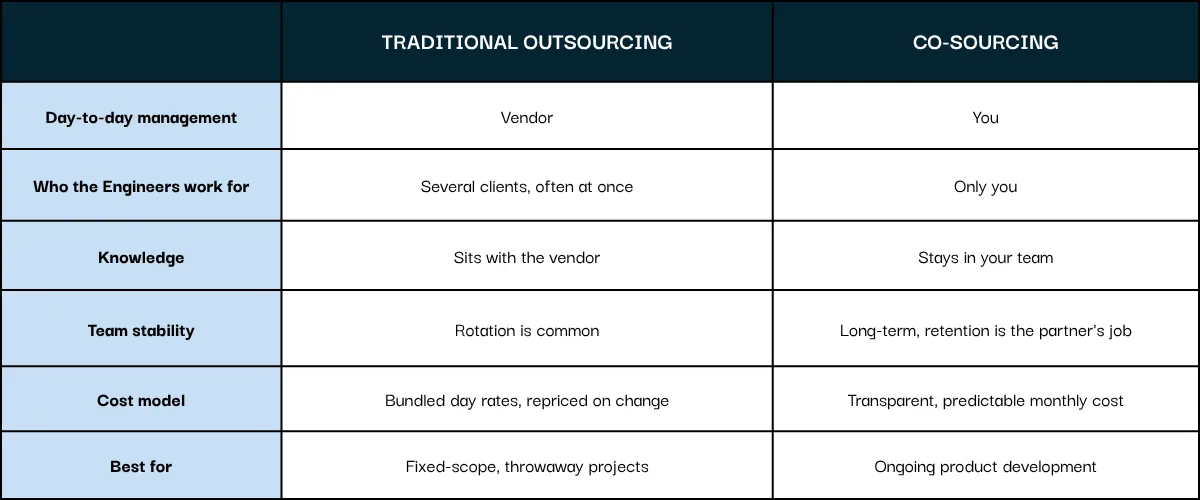
Outsourcing hands delivery to a third party that owns the team. Co-sourcing adds dedicated Engineers to your own team, while a partner handles hiring and employment.
Many vendors have simply renamed outsourcing, so the label alone says nothing. Ask three questions: who manages the Engineers day-to-day, who owns the knowledge, and will the same people be on your team next year? If the answers are "the vendor," "the vendor" and "probably not," it's outsourcing. Our piece on co-sourcing, not outsourcing, goes deeper into the model, and the co-sourcing model page walks through how it works with us.
Is outsourcing ever the right choice?
Sometimes, for tasks that do not affect the core product. For example, a marketing microsite, a one-off data migration, or a prototype that will most likely be discarded. If no one is going to maintain the code afterwards, it does not really matter who holds the knowledge about it.
For anything at the heart of your product, the problems above compound quickly, and adding more Engineers doesn't always mean faster delivery when they sit outside the team. For short, specialised work that still needs to sit close to your Engineers, such as an AI integration, our Mission Pods cover that middle ground without handing ownership away.
How do you choose an outsourcing or co-sourcing partner?
Five questions will tell you which model you're really being offered:
- Will these Engineers work only on our product?
- Can we interview and approve every person who joins?
- What's your Engineer retention rate, and what happens if someone leaves?
- Can we see a full breakdown of what we're paying for?
- Who owns the code and the IP, from day one?
Vague answers usually mean outsourcing under a new name. Our criteria for evaluating co-sourcing vendors cover the longer version.
You don't have to accept outsourcing's trade-offs
The objections UK tech leaders raise about outsourcing are fair. They're just not a reason to leave a role empty for half a year.
We've built dedicated engineering teams for UK companies since 2018, and from our commercial HQ in Bath we work closer to those clients than ever. Our Bulgarian Elite Engineers work only for you, inside your team, and stay for the long run. That's what Elite Systems. Elite Teams. means in practice.
Burned by outsourcing before? Talk to us about a team that stays yours.
Frequently asked questions
What are the biggest problems with outsourcing software development?
The most common are losing control of the team, developers rotating between clients, inconsistent quality, product knowledge staying with the vendor, hidden costs from rework and repricing, and confidentiality risks when developers work for several clients. Most of them come from the vendor, not you, owning the team.
How does co-sourcing solve the problems of outsourcing?
In co-sourcing, the Engineers work only for you, inside your team and under your day-to-day management, while the partner handles recruitment, employment and retention. You keep control, the knowledge stays in your team, and costs are transparent.
Is it safe to work with software Engineers in Eastern Europe?
For EEA countries such as Bulgaria, the UK has adequacy regulations in place, so personal data can be transferred under UK GDPR without extra transfer safeguards. You should still make sure Engineers work exclusively for you, on your infrastructure, with IP assigned to you from day one.