How to seamlessly integrate remote developers into your team?

- Business
- Co-sourcing

Building a high-performance engineering team used to mean finding the best people within a 30-mile radius of your office. Today, this strategy is a quick way to get left behind. The conversation has shifted from "can we work remotely?" to "how do we actually make these people feel like they are part of the company?"
Nobody wants a team which only performs specific tasks, sitting in a different time zone, disconnected from the whole company’s culture. You want a cohesive unit. For tech leaders, the real challenge is making remote collaboration feel less like a compromise and more like a high-performance engine.
At TechPods, the majority of our engineers work remotely. This hands-on experience has taught us exactly how to keep distributed teams engaged and deeply involved. By focusing on strong integration, we ensure our developers share the same mission as TechPods and our partners, all from the comfort of their homes. Here are some suggestions and advice you can use for your teams.
How to integrate remote developers into your team?
Integration does not start on day one - it starts from the moment the contract is signed. The biggest mistake companies make is treating a remote developer like a plug-and-play component. You cannot just give someone a Jira login and expect them to understand your culture immediately. First, you need to welcome the person appropriately. Most companies create a welcome email, but our recommendation is to have an onboarding doc which covers:
- The mission: Why are we building this? What happens if we fail? What is the 3-year vision?
- The unwritten rules: How do we handle Slack? Is it okay to stay silent for four hours of deep work, or do we expect instant replies?
- The technical stack: Do not just point them to the repo. Explain the "why" behind the architecture choices so they understand the logic they are stepping into.
The goal is to reduce "anxiety-to-contribution" time. The faster a developer feels they understand the environment, the sooner they will start delivering high-quality code.
Another suggestion at this point is to have a “buddy program”. Yes, it might sound old or a very common strategy, but we still believe it is one of the best. Why? Because it provides a low-pressure environment where a new hire can ask the practical, "non-technical" questions that usually get lost in formal onboarding guides. This also helps the new starter make a real friend at the "office" right away. Most people feel far less shy asking questions to a peer on the same level than they do reaching out to a manager or a CTO. Having that go-to person for "How do I actually get my access keys?" or "What's the vibe of the Friday meeting?" makes the transition into the team feel more natural and less stressful.
Which tools work best for real collaboration?
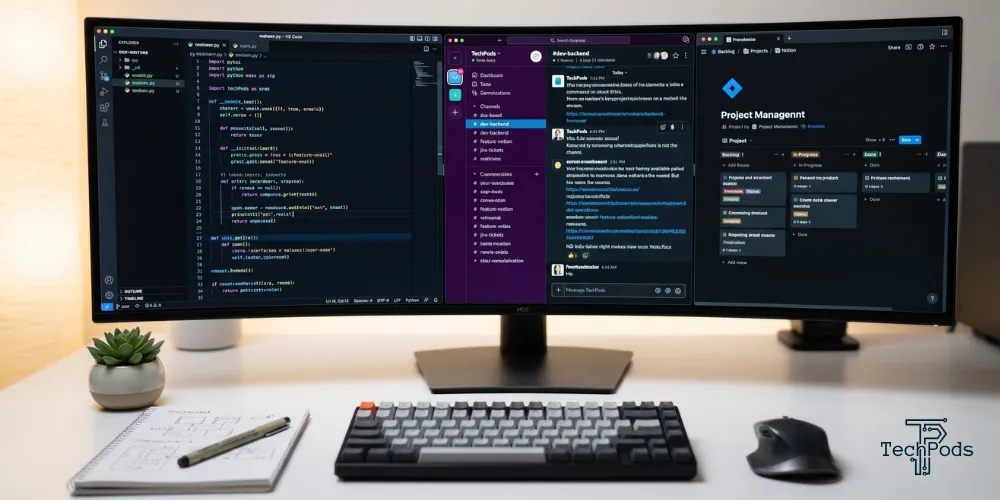
More tools usually mean more problems. You do not need the newest, shiniest AI task managers or all the other AI stuff. You need a reliable, integrated stack that everyone actually uses and understands. For communication, the most common ones are Slack or Teams, and they are the standard. However, it is how you use them which matters. Make them clear and ordered. Create channels for specific projects, but also create a space for informal chat. For example, in TechPods, we have such a channel on Slack, and what we notice is higher engagement there. People are constantly joking and sending memes, which helps them feel like they are at the office and talk with their colleagues. It sounds small, but that is where trust is built. If people only talk about their projects or tasks, they never build this connection, which makes the best high-performing team.
For project management, Jira remains one of the most used tools. However, here there is a simple rule - if it is not in the ticket/written down, it did not happen. This prevents the "I thought we discussed this during the daily/that call" trap that often leaves remote developers in the dark.
What we noticed in the years is that most teams fall apart with the documentation part. If your documentation is a mess of Google Docs and random Notion pages, your remote developers will spend 30% of their day just looking for information. Confluence or Notion should be your single source of truth. If a process changes, the doc changes. This level of discipline is what separates productive teams from frustrated ones.
How to avoid siloing in distributed teams?
Siloing is the silent killer of remote teams. It sometimes has this feeling of “us vs. them” mentality, which happens when an informal meeting happens in front of the coffee machine, and people at the office forget to update their online colleagues. To avoid this, you have to adopt a remote-first mindset, even if half your team is working physically from the office. This means if even one person is remote, the whole meeting happens on camera. No more three people in a conference room and one person on a laptop screen, feeling like a ghost.
Peer reviews are another massive silo-buster. Do not just have in-house developers review remote code. Flip it. Have the remote developers review the lead architect's code. It levels the playing field and shows that everyone’s work is subject to the same standards.
We also suggest regular "Show and Tells." Once every two weeks, have someone (remote or local) demo a cool feature they built or a bug they smashed. It reminds everyone that they are part of a winning team, not just a line in a spreadsheet.
How to measure success without micromanaging?
How do you know they are actually working? If your answer is tracking mouse movements or counting hours, you have already lost. It destroys trust faster than a leaked password. You hired seniors, so treat them like such. Companies should turn their focus and start measuring outputs, not activity. Of course, we don’t mean that people should not be available when you need them, but still, the results are what matter.
To measure the success properly, you can focus on the following metrics:
- Cycle time: How long does it take from an idea being a ticket to it being live code?
- Sprint burndown: Are we actually finishing what we promised?
- Code quality: Are the PRs being kicked back constantly, or is the logic sound?
- Peer feedback: Do people enjoy working with this person? Are they helpful and proactive in communication?
When the remote developer is hitting milestones and the code is clean, it does not matter when they do the work. The beauty of a global team is the ability to focus on results rather than the time spent at the desk.
The future of staffing is about agility and finding the best talent regardless of borders. Mastery of the global team model is what will define the leading tech companies of 2026. By focusing on deep integration, clear documentation, and a culture of transparency, you turn remote work from a logistical challenge into a primary competitive advantage.
At TechPods, we help businesses navigate these complexities through a proven co-sourcing model. We recognise that traditional outsourcing often fails due to a lack of integration and cultural alignment. That is why we focus on creating a unified workforce where our specialists become a long-term, seamless part of your in-house operations.
Frequently asked questions
When should remote developer onboarding start?
Onboarding should begin at the contract-signing stage. An onboarding document covering the company’s mission, cultural norms, and technical architecture rationale can help developers understand the environment more quickly.
How can companies avoid information silos with remote developers?
Information silos could be addressed through a remote-first communication approach, ensuring that remote developers have the same access to meetings and information as in-office employees.
How should you measure the performance of remote developers?
Focus on outcomes like cycle time, sprint completion, and code quality rather than activity monitoring, which builds trust and supports senior-level autonomy.