
Your team's recruiter uploads the job posting on Monday, and by Friday there are eighty applications. However, a third are solutions Engineers who've never deployed anything to production, and the other third have great CVs but have only worked from a well-groomed backlog. The handful left look promising, and every other company with an AI budget is talking to the same people.
That's what hiring forward-deployed Engineers looks like for most CTOs right now оr technical recruiters. Demand has grown much faster than supply, and the title itself has become very fuzzy. This article explains how to determine whether you need an FDE, what to look for, where to find qualified applicants, how to interview them, and why hiring a partner is preferable to doing your own search.
If you're still getting to grips with the role itself, our complete guide to forward-deployed engineers is the place to start.
Why are forward-deployed Engineers so hard to hire?
Three reasons, and they compound each other.
- Demand has moved very fast.
Postings with this title increased by 1,165% between January and October 2025 compared to the same period a year earlier, according to Bloomberry's analysis of 1,000 FDE job postings using data from Revealera. The number of individuals with actual FDE experience has not increased at all.
- The profile is rare.
An FDE needs the engineering ability of a strong senior developer and the confidence to run a workshop with a finance director. Plenty of people have one of those. Far fewer have both.
- Nobody agrees what the job is.
The same Bloomberry analysis split FDE roles into three types. About 60% were builder roles centred on coding and deploying software. Approximately 30% seemed closer to sales engineering involving some coding, while about 10% focused on creating internal tools. When your advertisement fails to specify which one you mean, you'll draw all three.
Do you actually need a forward-deployed Engineer?
It's worth checking before you start. Tiffany Siu, Head of Talent at First Round Capital, told the First Round Review that founders often start a search asking for an FDE and realise, a few conversations later, that they really need a software Engineer or a post-sales role such as an implementation consultant.
She starts by posing a few straightforward questions. What caused this opening to occur? Who is working on this project today? What occurs when you don't hire anyone? The answers generally reveal whether the gap concerns construction, customer ties, or ownership of the space separating parties in question.
You probably need FDE-style work if:
- You have AI or platform projects that function in demos but haven't become part of everyday use.
- The business and your technical team are constantly losing track of requirements.
- The most challenging aspect of the work is integrating software with chaotic, inadequately documented systems and workflows.
If that sounds like your situation, our article on why AI projects get stuck in proof-of-concept goes into more detail. And if you're not sure whether you need an FDE or a different role altogether, our comparison of FDEs, solutions Engineers, solutions architects and consultants can help.
What should you look for in a forward-deployed Engineer?
Four qualities matter more than anything on a CV.
Technical depth they can prove
“Engineer” is still the title’s single most important key term. The FDE will build production software, integrate it with systems they didn't create, and keep it operational. According to the First Round article, many of the top FDEs may have gone on to become staff Engineers at prestigious tech businesses, and Palantir's early FDEs had to pass the same interview rounds as its software Engineers.
Don't lower the technical bar because the role is customer-facing. A charming FDE who can't ship is a consultant with a laptop.
Comfort in front of non-technical stakeholders
This is where many skilled Engineers often fail. An FDE must explain compromises to someone unconcerned with the underlying technology, recognise when a request diverges from the business's actual needs, and respectfully challenge it directly without harming the working relationship. Bloomberry found working directly with customers was the single most common responsibility in FDE job ads, mentioned in 55% of them.
Judgement when the brief is unclear
FDEs are not often given a clean spec. They receive a problem, some partial data, and a deadline. You want someone who can make smart decisions without permission, who knows what decisions they don’t want to make on their own.
In 2026, that also includes evaluating AI-generated output. A lot of an FDE's work today involves AI-written code and AI-driven features, and what distinguishes a strong FDE from an average one is knowing exactly when the output is fit to ship. We look at how to test for this in how to hire AI-native Engineers.
Real curiosity about how businesses work
The strongest FDEs seek to understand why a process exists, not merely how to automate it. James Honsa, former Head of Legal Engineering at Ironclad, says the best people on his team were Engineers energised by exploring the intricacies of a customer’s business. That curiosity transforms a technical solution into something people genuinely use.
"There's no one to hire": where good FDEs actually come from
You'll hear this a lot, and it's only half true. There aren't many people with "forward-deployed engineer" on their CV. There are plenty of people who could do the job well.
Bloomberry looked at 100 LinkedIn profiles of current FDEs and found that the most common route into the role is from software engineering, typically after three to five years of building experience. It's much easier to teach a good Engineer to work with customers than to teach a salesperson to write production code.
So widen the search:
- Senior software engineers who've worked close to users, for example on internal tools, integrations or B2B products with demanding clients.
- Engineers from consultancies and agencies who have shipped real systems, not just prototypes.
- Founders and early startup Engineers, who are used to owning a problem end to end.
- Solutions Engineers with strong production experience. Some make excellent FDEs, but check that they've deployed and maintained real code.
Experience matters, but doesn’t need to be extreme. In the Bloomberry data, 60% of roles in FDE that called for experience wanted three to five years’ experience, while only 8% wanted nine years or more. The First Round panel also cautioned that some very experienced candidates can be too set in their ways for a role that changes with every client.
How to write a forward-deployed Engineer job description
A good FDE job description is built around an outcome, not a list of technologies. It also makes clear which type of FDE role you're hiring for, so you don't get applications from all three.
Here's a short template you can adapt:
“Forward Deployed Engineer
The problem you'll own: [One sentence on the outcome, e.g. "Get our AI-assisted claims process from pilot into daily use across three regional teams."]
What you'll do:
- Spend time with the teams who'll use the system to understand how the work really happens
- Build and deploy production code that connects [product/AI] to [named systems]
- Agree success measures with stakeholders and report against them
- Stay with the solution after launch until it's adopted and working
What you'll bring:
- [3-5+] years building and shipping production software
- Experience integrating with APIs, databases and existing systems
- Confidence explaining technical trade-offs to non-technical people
- Good judgment when using and reviewing AI-generated code
What this role isn't: a pre-sales role, and not a role that hands over at launch.
How we'll measure success: [The one or two numbers that matter, e.g. hours saved per week, adoption rate.]”
That "what this role isn't" line does a lot of work. It filters out candidates looking for a sales engineering role before they apply.
Forward-deployed engineer interview questions that reveal ownership
Standard coding interviews won't tell you much on their own. Keep a technical assessment, but add questions that show how candidates think when the problem is messy. A few that work well:
- "Walk me through a problem you solved from start to finish." According to the First Round article, Ironclad’s most effective interview approach was to ask candidates to describe a real problem from their career and explain how they used technology to address it. Listen for whether they talk about users and outcomes, or only about code.
- "Tell me about a project that didn't work at first. What was the real cause?" Good answers mention data, access or people, and what the candidate changed. Weak answers blame the client or claim nothing ever went wrong.
- "Here's a problem one of our teams is facing. How would you approach it?" Palantir used open-ended customer scenarios in its FDE interviews, asking candidates what data they'd need and what questions they'd ask before proposing anything. You want questions first, not an instant architecture diagram.
- "Explain this technical decision to our operations manager." Role-play it. Strong candidates use plain language, check understanding and invite questions.
- "Tell me about something you were asked to build and didn't." This is the best single test of ownership. A good FDE can tell you about a request they pushed back on and why it would have slowed the real result. If someone has built everything they’ve ever been asked to build, they’re probably a very good order-taker.
- "How do you decide whether AI-generated code is ready for production?" Look for a clear process: tests, edge cases, review, and an honest view of where AI tends to get things wrong.
For a broader set of signals, our 10-point checklist for what makes an Engineer elite covers the habits that separate great Engineers from good ones.
Red flags to watch for
- Talks about frameworks and models, but never about users.
- Wants a full specification before starting anything.
- Has a portfolio made up only of demos and hackathon projects.
- Can't name a single production system they built that's still running.
- Describes every past project as a one-off, with nothing reused or improved.
"We need someone next month": in-house hiring vs an embedded partner
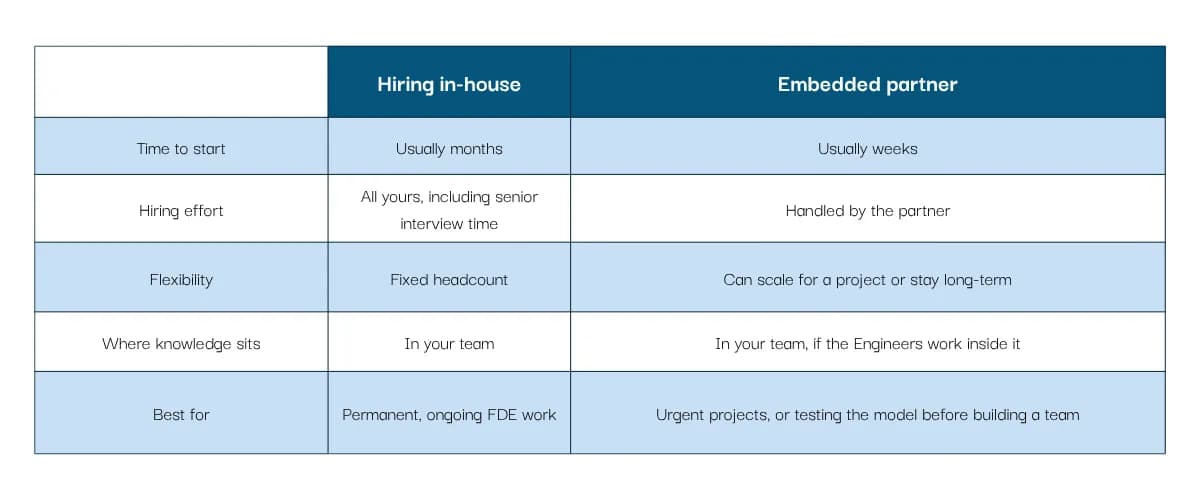
Hiring an FDE in-house can be the right long-term move, especially if FDE work will be a permanent part of how you deliver. But it's rarely quick.
A senior engineering search typically takes months from opening the role to a first day, once you add sourcing, several interview rounds and a notice period. Your senior Engineers spend a good part of that time interviewing instead of building. And once the FDE is hired, the work doesn't always arrive evenly. There may be quiet periods between big projects when you're paying for a specialist you don't fully need.
An embedded partner solves a different problem. If you need FDE-style work on a specific project now, such as taking a stalled AI integration into production, a partner can provide experienced Engineers who work inside your team much sooner. Research from MIT, which we cover in our article on AI pilots, found that AI projects delivered with external partners succeeded about twice as often as purely internal builds.
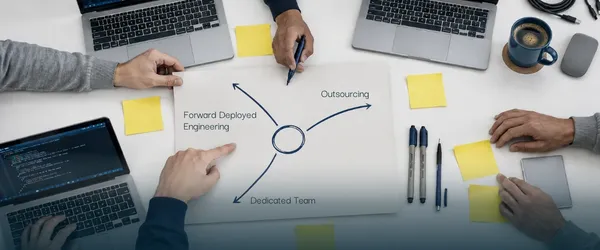
The trade-off is control and knowledge, so the model matters. A partner that delivers from outside your team, against a fixed scope, will bring back the same handover problems that make FDEs useful in the first place. We compare the options side by side in forward-deployed engineering vs outsourcing vs a dedicated team.
What to look for when choosing an FDE partner
If you go down the partner route, ask these questions before you sign:
- Will the Engineers work inside our team, in our tools and meetings, or deliver from outside?
- Can we interview and approve every Engineer before they join?
- Will they work only on our project, or split their time across several clients?
- Who owns the code, the documentation and the knowledge at the end?
- How do you vet for judgment and communication, not just technical skill?
- Can the arrangement flex, from a focused project to a longer engagement, without starting again?
Vague answers to the first three are usually a sign you're being offered outsourcing with a new label.
How we help
We have spent years building teams of Engineers that work the way described in this guide. Our Engineers are embedded right in our clients' teams, participating in planning and standups and talking to the people who will be using what they build. Through our co-sourcing model, you interview and approve everyone who joins, the knowledge stays in your team, and we take care of recruitment, employment and retention.
This is effective for long-term product teams and equally suitable for urgent issues requiring FDE-style ownership, like advancing an AI project beyond the pilot phase. If you're about to start an FDE search, or you're already a few months into one, talk to us.