Capacity vs Capability: a new framework for sizing engineering teams

- Business

Let’s imagine CTOs at “X” company decide the technical team is falling behind and needs help. They greenlight four new engineering hires in Q1, and everything is set - budget is approved, offers signed, onboarding scheduled. Nine months later, the roadmap looks almost exactly like it did before the hires arrived, except now there are four more people in the standup.
Don’t get us wrong. This is not a hiring failure. It's a measurement failure. The CTO sized the team by capacity (how many people, how many hours) when the real constraint was capability (what those people, working together, can actually turn into shipped software). Knowing the difference between the two is crucial. If you confuse them, it is most likely that you will end up with a bigger team that moves at the same speed, or slower.
In this article, we will break down what capacity and capability actually mean for an engineering team, why the gap between them is expensive, and how to size a team around what it can deliver rather than headcount.
What is engineering capacity?
Let’s start by defining capacity. Look at it as the resource side of the equation.
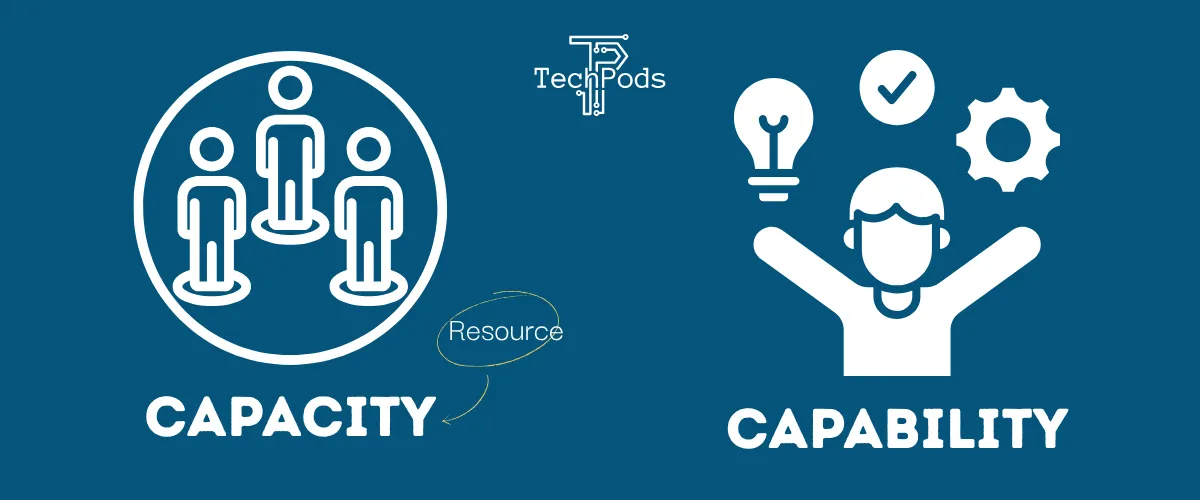
It basically refers to how many Engineers you have, how many hours they are billed, and how many sprints are on the calendar before a deadline. It's the number that shows up in your headcount plan or the resourcing spreadsheet.
Capacity is arithmetic. Thus, it is easy to measure. Ten Engineers at 35 productive hours a week is 350 hours of raw capacity. It's also this metric that most C-levels default to, because "we grew the team from 15 to 22" sounds like progress in a way that's simple to report upward.
Although it is a brilliant metric to follow the growth of your team, it has its limitations, as bigger team size doesn’t always mean higher productivity or closed tickets. The problem is that capacity tells you nothing about the quality of output. Ten Engineers who each spend a third of their week in meetings, fixing tests, or waiting on a code review have a lot of capacity and very little of it converts into working features for your project.
What is engineering capability?
If capacity is the resource side of the equation, capability is the output side.
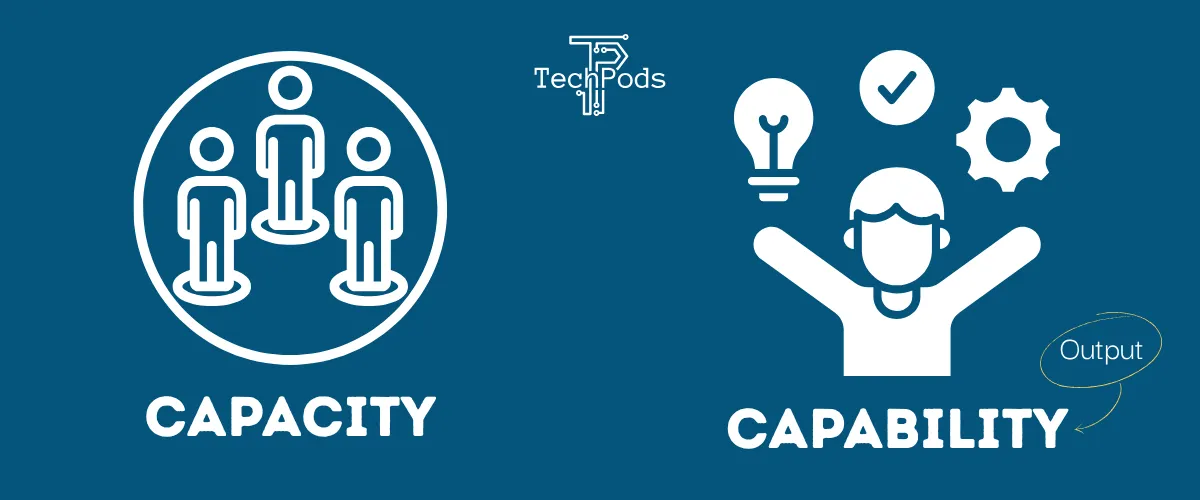
It defines what a team can actually deliver with the capacity it has. It is not measuring only one thing, just the opposite. It is a combination of more than one thing, like technical skill, system maturity, decision-making judgement and how much Software Engineers have to act on that judgement without waiting for sign-off.
It is crucial for the CTOs to understand that two teams with identical headcount can have wildly different capability. One team of six can ship a complex feature end to end with almost no hand-holding. Another team of six, doing the same job title on paper, needs a senior Engineer to review every pull request and an Engineering Manager to untangle every architectural decision.
Same capacity. Different capability.
This is also why "we need more Engineers" is often the wrong diagnosis. Yes, in some cases companies need more people and a whole team of Engineers, but if the constraint is capability like unclear ownership, fragile systems, or the need for constant oversight, adding more people will add more of the same problem. In a few words, you will get a bigger version of a team that was already struggling to convert time into output.
Why do CTOs keep confusing the difference between capacity and capability?
There's a reason this mistake is so common, and it dates way before modern software teams. In 1975, Fred Brooks wrote what's now known as Brooks's Law: adding manpower to a late software project makes it later. His argument was really simple and very relevant now. New people need to be brought up to speed by those who are already working, which temporarily reduces the team's output. Communication overhead also grows faster than headcount, because every additional person adds more lines of communication to the team, not just one more contributor.
Half a century later, the same maths applies to a team choosing between hiring its fifth Back-end Engineer or investing in its third senior one. As it was mentioned above, more people on the team makes it more complicated sometimes, as there are more people in the standups, more threads on Slack to follow, more pull requests to review. Thus, more surface area for context to get lost. None of that shows up as a negative number on a capacity plan. It shows up months later as a roadmap that hasn't moved.
For a CTO, this gap has a direct cost. Headcount used to be the number boards were proud of. Now it's increasingly treated as a cost line to justify, and "we added Engineers" is a much harder answer to defend than "we shipped X, Y and Z." Sizing a team around capacity alone means the growth is visible on the organisational chart and invisible on the roadmap.
The Capacity vs Capability Framework
Once you separate the two, most engineering teams fall into one of four positions.
High capacity, low capability
The team is large, but coordination costs, technical debt or skill gaps mean output doesn't scale with headcount. This is the most common (and most expensive) place to be, because it looks fine on a resourcing chart and feels wrong every sprint.
- Low capacity, high capability
A small, senior team that ships more than its size suggests, but has little slack for demand spikes, holidays or someone leaving. Efficient, but fragile.
- High capacity, high capability
A team that's both well-staffed and highly effective. This is the position every CTO wants to reach, and it's rare, because it usually means paying for senior talent at scale rather than filling seats.
- Low capacity, low capability
The crisis quadrant: not enough people, and the people you have are stretched too thin to build the systems and habits that would make them more effective. Usually the result of hiring freezes layered on top of years of underinvestment in tooling and process.
Most sizing conversations start and end with the question "how many people do we need," without ever checking which quadrant the team is actually in. The framework only becomes useful once you measure capability directly, which is the harder, less comfortable part of the exercise.
How to audit your team's real capability
Before deciding how many Engineers your team actually needs, it's worth running a short capability audit on the team you already have. Four questions do most of the work.
- Skill depth
Question #1: Can your Engineers solve unfamiliar problems without escalating to a senior every time, or does most non-routine work funnel through one or two people?
- System maturity
Question #2: Is your CI/CD pipeline, test coverage and deployment process solid enough that shipping is routine, or does every release require manual babysitting?
- Autonomy
Question #3: How much of your team's work moves forward without waiting on approval, clarification or a manager to unblock a decision?
- Judgement
Question #4: When Engineers hit an ambiguous situation, do they make a reasonable call and move, or does ambiguity stall the whole team?
The result:
- A team that scores well on all four can often absorb more scope with the people it already has.
- A team that scores poorly on two or three of them will struggle to convert new hires into new output, because the bottleneck isn't headcount. It's everything around the headcount.
How many developers do you actually need? A capability-first sizing method
There isn't a universal number, but there is a more reliable order of operations than "add people until the bubble bursts".
- Step #1: Start with the outcome, not the organisational chart.
First of all, define what needs to be shipped, by when, and what "good" is in your opinion. Aim to make decisions based on performance goals, not sizing, because again, you’ll just go for more employees without a clear plan.
- Step #2: Run the capability audit first.
If the gap is skill, autonomy or system maturity, hiring more people at the same level won't close it. You may need fewer, more Senior Software Engineers rather than more mid-level ones.
- Step #3: Use ratio frameworks as a sanity check, not a formula.
Engineering leader Will Larson's widely referenced guidance suggests teams of 6-8 Engineers per Line Manager and a minimum viable team size of around 4, since smaller groups tend to function as individuals rather than a team. Amazon's "two-pizza team" principle points in a similar direction: small enough to stay coordinated, large enough to own real scope. These are useful guardrails once you know what the team needs to deliver, not a substitute for that decision.
- Step #4: Fill true gaps with capability, not with volume.
If three senior Engineers can deliver what five mid-level ones would take longer to build and then spend months maintaining, the smaller team is the cheaper option, even before accounting for management overhead, onboarding time and the code review load that comes with every additional junior hire.
Does AI Change the Capacity vs Capability Equation?
AI coding tools have made it easier than ever to increase raw output, more code, more pull requests, more tickets closed. That's a capacity gain. Whether it's also a capability gain depends entirely on who's holding the tool.
An Engineer with strong judgement uses AI to move faster through work they'd have done well anyway, and reviews the output critically before it ships. Someone without that judgement uses the same tool to produce more code, faster, that someone else eventually has to untangle. The tool doesn't close the capability gap between the two. It widens it, because both Engineers now deliver more of whatever they were already delivering.
AI adoption is not a substitute for a capability audit. If anything, it makes that audit more important, since it's now easier than ever to mistake a higher volume of output for a more capable team.
Building Capability-First, Not Headcount-First
Let’s make it clear: none of this means capacity doesn't matter. A successful CTO just needs to understand the difference and know where to start.
A capable team with zero spare capacity still misses deadlines. But when the two are in conflict, and they usually are under budget pressure, capability is the constraint worth solving for first. A smaller team of Engineers who own their systems, make sound calls without hand-holding and ship without a queue of approvals will consistently outperform a larger team assembled to hit a headcount number.
This is also why more CTOs are rethinking what "scaling a team" should mean in the first place, moving away from measuring growth in seats and toward measuring it in what the team can actually own. Fewer, more senior, more deeply integrated Engineers, working as part of the team rather than adjacent to it, tend to close the capacity vs capability gap faster than a larger team ever could.
It's the same shift behind TechPods' own move from “Co-Sourcing, Not Outsourcing" to “Elite Systems. Elite Teams.” We focused on dedicated Engineers who join your standups, own outcomes rather than tickets, and stay long enough for their judgement to compound. If your next hiring decision is really a capability question wearing a headcount request, that's exactly the kind of audit we help CTOs run before a single job spec goes out. Talk to TechPods about finding the two or three Elite Engineers who would actually move your roadmap, instead of the ten who would just sit on it.
Често задавани въпроси
What's the difference between capacity and capability in an engineering team?
Capacity is how many people and hours you have available. Capability is what that team can actually produce with them, based on skill, system maturity, autonomy and judgement. A team can have high capacity and low capability at the same time.
Can you increase capability without adding headcount?
Yes. Investing in system maturity (CI/CD, code quality, technical debt reduction), increasing Engineer autonomy, and hiring or developing more senior judgement within the existing team all raise capability without touching headcount.
Does hiring more developers always speed up delivery?
No. Our experience shows that adding people increases coordination and onboarding overhead, which can slow a team down before it speeds one up, especially on already-complex projects.