The Future of Staffing


The era of "traditional" recruitment is coming to an end. As 2026 is already here, it has brought its novelties. Most probably, the people in the industry have already faced some of them, like the convergence of a persistent global skills gap, the rise of agentic AI or the permanent shift toward flexible work models. However, all of them are creating a new blueprint for growth.
At TechPods, we’ve always believed that no matter the trends or the changes in the staffing industry, co-sourcing has always been the key to long-term success, as it is the more stable model compared to the other team scaling options. Let’s dive deeper into the trends this year, break them down and see how they affect the co-sourcing model.
What staffing trends are coming?
The most significant trend which emerged this year is the transition to the so-called "skills-first" Economy. We see employers moving away from rigid degree requirements. They are no longer interested in "pedigree" hiring, meaning that they don’t rely on university names or past company prestige in favour of validated competencies. Recent industry reports show that 92% of employers now prioritise validated skills over traditional degrees. The whole shift is about survival, as the World Economic Forum predicts that 50% of all employees will need reskilling by 2025, and companies can no longer afford to wait for the "perfect" candidate to appear. Now, managers rely on skills-based hiring as it has proven to expand talent pools by up to 19 times. They focus on what a candidate can really do instead of “ where they went to school” because this helps them to find hidden gems in untapped markets, significantly reducing the "time-to-fill" for critical roles.
2026 comes with one more shift that we observe in the market, and this is “internal mobility”, meaning that most probably your next great hire is likely already on your payroll. Companies are starting to integrate AI platforms that map existing employees' skills to new project needs, allowing firms to "rent" their own internal talent for cross-functional initiatives.
Another shift that is rising is the “fractional leadership”, which means that a lot of mid-market companies are increasingly hiring "part-time" C-suite experts to provide high-level strategy without the need to pay their high salaries. It might sound unusual, but this "on-demand" executive model is a direct response to the economic volatility expected to continue through 2026.
How does co-sourcing fit future staffing?
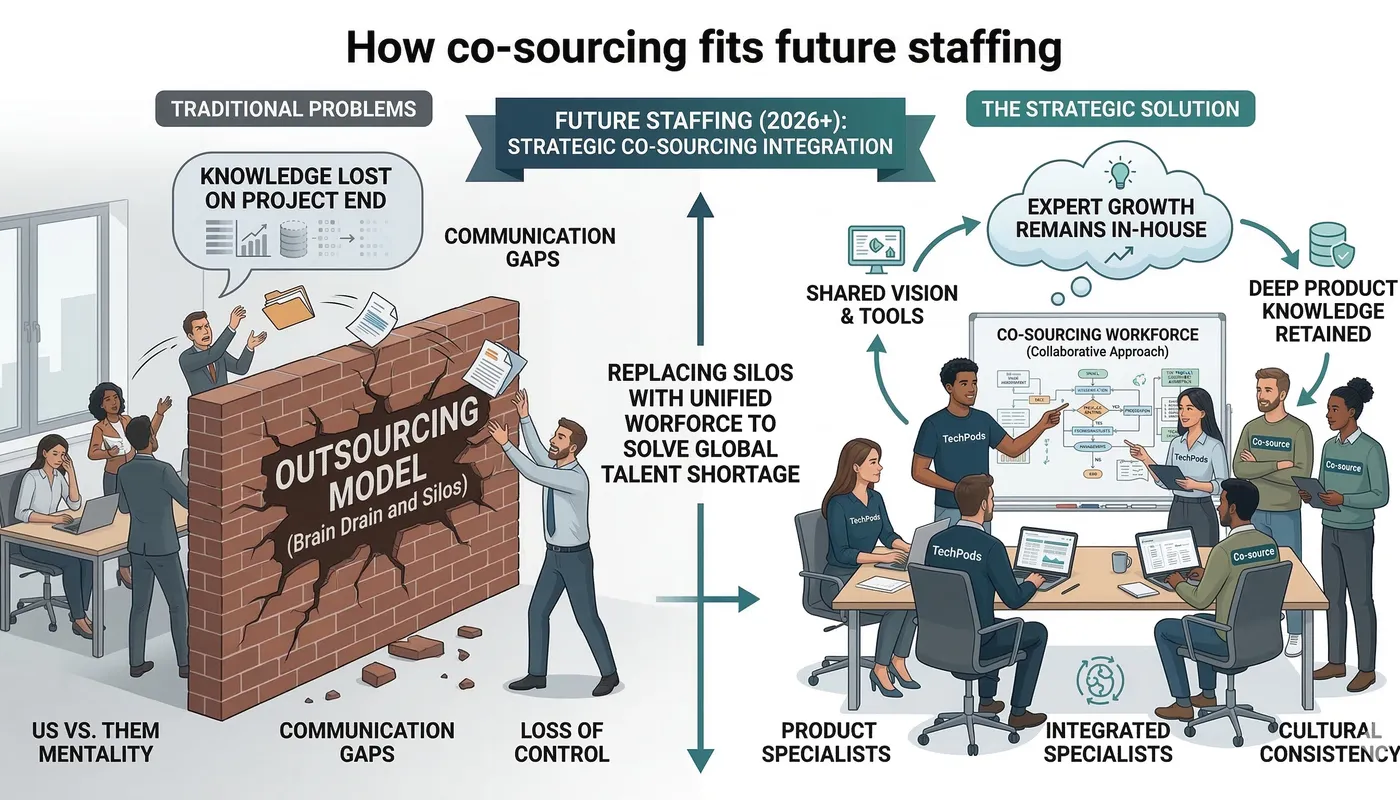
If 2024 was about "doing more with less," 2026 is about strategic decisions, and co-sourcing fits well in the bigger picture. The most common problems that come from the traditional outsourcing model, like "us vs. them" mentality, communication gaps, and a loss of control, are now replaced with a more integrated approach that eliminates them all. In outsourcing, project is usually "thrown over the wall" to an external vendor, but our co-sourcing offers a collaborative approach. It integrates external specialists directly into your in-house teams, creating a single, unified workforce. Talking about outsourcing, it is important to mention one more drawback, the so-called "brain drain" when the project ends. With co-sourcing, the way of working is totally different. It ensures that your internal team grows by working alongside external specialists. When the project finishes, the expertise stays in-house because the external talent worked with your team, not in a silo.
Another crucial benefit of the co-sourcing model is that it allows businesses to scale up for a product launch or a digital transformation while maintaining the cultural consistency and deep product knowledge that only a long-term partnership can provide. Expected to reach 85 million unfilled jobs by 2023, the global talent shortage puts immense pressure on companies, and the co-sourcing acts as a "safety valve”.
Will remote teams dominate?
In 2024, people were forced to adapt to the turbulence that COVID-19 brought. People needed to learn how to work 100% remotely or in a hybrid environment. This, in turn, made people get used to these two work models and start demanding them from their employers in 2025, but this caused debates and additional questions. By 2026, the debates are over: remote and hybrid teams are the standard.
This evolution has moved beyond a simple change of scenery to become a structural pillar of the modern corporate world. The following data highlights how this "new normal" has solidified into a permanent competitive advantage for both businesses and talent:
- The 52% majority: The percentage of workers worldwide who work remotely has almost doubled since the pandemic began, and it currently stands at 52%. This percentage is considerably greater in the tech industry, where 68% of software positions in the US may be done remotely.
- The European & Bulgarian landscape: About 36% of all employment postings in Europe are remote or hybrid, but in the IT industry, this number rises to 50%. Nearly 80% of ICT companies in Bulgaria provide flexible solutions to accommodate a workforce of over 126,000 specialists working for international markets, making remote work a structural pillar.
- The "Flexibility Premium": Talent now mostly trades in flexibility. 76% of employees say they would think about quitting a job that didn't allow for remote work. Offering remote flexibility has evolved from a "perk" to a crucial retention tactic for businesses.
- The rise of nearshoring: A significant trend toward nearshoring is now underway. Businesses are choosing talent hotspots like Bulgaria over low-cost, high-friction areas. These areas are perfect for co-sourced teams because they provide a "proximity premium" that includes cultural compatibility, time zone alignment, and top-notch technical education.
The question in 2026 will not be whether or not to work remotely, but rather how to cope with the so-called "loneliness epidemic" and "Zoom fatigue". In order to preserve the social cohesiveness that distant work might occasionally erode, businesses are now investing in "digital culture" technologies and high-impact quarterly in-person gatherings.
How is AI affecting the staffing industry?
The emergence and development of AI cannot fail to change the staffing industry. This might sound scary, but some trends that we see in the industry on a global scale are:
- Your next hire might not be human.
Talent managers are hiring autonomous AI agents, a new kind of coworker, in 2026. These are digital beings with their own Slack profiles and rights, not only chatbots. Without human assistance, they are able to recruit candidates on their own, perform technical assessments, and manage 80% of transactional scheduling.
- AI as a "Power Couple" with humans.
In 2026, 84% of talent executives anticipate using AI. The human recruiter is to be promoted from "administrator" to "advisor." Humans concentrate on the "human intelligence" components - cultural fit, empathy, and sophisticated negotiation, while AI takes care of the high-volume data processing.
- Predictive success modelling
AI systems in 2026 employ predictive analytics to assess a candidate's chances of long-term success based on past performance data and team dynamics, rather than merely searching resumes for keywords. As a result, early adopters' "Time-to-Hire" has been decreased by 40 - 60%.
- The challenge of candidate fraud
As AI helps recruiters, it also helps candidates. 2026 has seen a surge in "AI-enhanced" candidate fraud, where applicants use real-time AI to ace technical interviews. This is forcing staffing firms to adopt more rigorous, live, and practical "whiteboard" assessments to verify true competency.
AI benefits applicants in the same way that it benefits recruiters. The usage of "AI-enhanced" candidate fraud, in which candidates employ real-time AI to ace technical interviews, has increased since 2026. In order to confirm actual proficiency, staffing companies are being forced to implement increasingly stringent, real-time, and useful "whiteboard" tests.
The changes we observe in 2026 indicate that the new way of growing is a basic fact that all businesses need to grasp, not just a prediction. Although the demise of traditional hiring practices and the emergence of AI-driven, skills-first models may appear disruptive, they present a previously unheard-of chance to create more resilient companies. Businesses may use co-sourcing to transform these global issues into a competitive advantage by eschewing antiquated outsourcing or high-risk direct recruiting. This will keep their workforce cohesive, stable, and prepared for whatever comes next. We at TechPods are prepared to support you during this change by offering the knowledge and enduring collaboration required to prosper in this age of ongoing change.
Frequently asked questions
What are the biggest staffing trends shaping hiring in 2026?
Key trends include skills-first hiring, internal talent mobility, integrating AI platforms to match employee skills with project needs, and "fractional leadership", meaning increased hiring of "part-time" C-suite experts.
Why are companies choosing Co-Sourcing over traditional outsourcing for staffing?
The Co-Sourcing model integrates external specialists directly into the in-house teams, creating a unified workforce. This collaborative approach helps prevent the ‘brain drain’ that can occur when outsourced projects end, as internal teams retain the knowledge and expertise gained through collaboration.
How is AI changing the recruitment and staffing process?
AI now handles tasks like assessments and scheduling while recruiters shift toward advisory roles, though it has also pushed firms toward more rigorous, real-time skills assessments to counter AI-assisted interview manipulation.