Co-Sourcing vs Staff Augmentation in the AI Era: What Actually Changed
- Business
- Tech
- Co-sourcing

If AI increases the speed of every engineer, does it still matter how you incorporate outside engineers into your team? It does indeed. Not for the reasons most comparison guides suggest.
For much of the past ten years, the decision between staff augmentation, outsourcing, and co-sourcing primarily revolved around workforce numbers and expenses. Did you require some additional assistance for six months, or a team that would expand alongside the product?
AI has altered what you are truly purchasing. A developer with an efficient coding assistant can produce in one afternoon what once required a week, making hours of typing no longer a rare occurrence. What is currently lacking is judgment: an individual who understands your system sufficiently to assess if the produced code is correct, and who will still be available when that code fails in production three months down the line.
That change doesn't eliminate staff augmentation or outsourcing. It alters the way each model generates revenue, shifting the boundary between them. Here, we examine what evolved and what remained constant.
What is the difference between co-sourcing and staff augmentation?
The terms get used loosely, so here is how we use them in this blog. On one side sit the models most companies already know: staff augmentation, project outsourcing and nearshore or offshore vendors. On the other sits co-sourcing.
- Traditional models
Staff augmentation brings in specific engineers to your team for a defined duration, allowing you to oversee their tasks. Outsourcing grants a vendor the opportunity to manage it using their own personnel and methods. Nearshoring refers to either of those located in a nearby time zone. They vary in who manages the tasks, yet they share a commonality: the individuals are part of the vendor and are seldom present for an extended period. Engagements conclude, engineers transition between clients, and the knowledge they gained about your product leaves with them.
- Co-sourcing
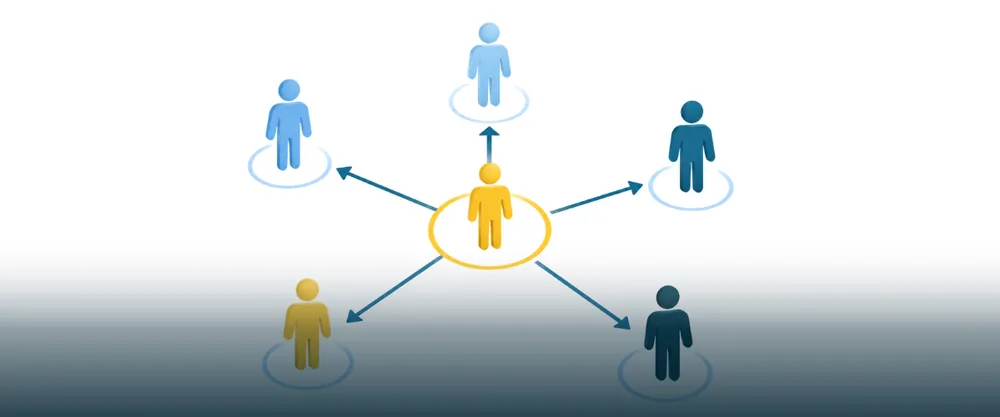
Executing it entails creating a specialised team that exclusively serves your needs. You manage it the way you manage your internal engineers: identical standups, the same backlog, and the same code review. The partner employs the people locally and takes care of hiring, HR, payroll and retention, with the costs shown openly. It is built to last for years, not months.
The location does not make a difference. Our engineers are located in Sofia, making us technically nearshore for a UK company as well. What distinguishes co-sourcing is time and responsibility. Conventional models lease capacity or purchase outputs. Co-sourcing develops a team that remains under your guidance and continually learns your product, year after year.
How has AI changed staff augmentation and outsourcing?
1. Hours stopped being a good unit to buy
Staff augmentation and outsourcing have traditionally been priced based on time or volume: daily rates, seats, and fixed-price scopes determined by effort. That was logical when the output closely followed the hours spent typing. It monitors with significantly less precision now.
The gains are also harder to pin down than they look. In Stack Overflow's 2025 Developer Survey of more than 33,000 developers, 84% use or plan to use AI tools. Yet 46% distrust the accuracy of what those tools produce, and 66% name the same top frustration: AI answers that are "almost right, but not quite". When you pay for time or volume, you pay for the almost-right code and for the hours spent fixing it.
2. Context became the asset
AI assistants depend heavily on the context provided and the individual supplying it. An engineer with two years' experience in your codebase understands which module is vulnerable, the reason behind that peculiar workaround, and which client will notice if it modifies. They encourage improvements, and they detect the bold nonsense more quickly.
Whenever a contractor departs, that context goes with them. As AI increasingly handles more code, understanding the system is more important than merely typing quickly. Continuity was once considered a desirable feature for augmented positions. Now it is nearly the entire point.
GitClear's analysis of 211 million changed lines shows what happens when nobody holds that context. Between 2021 and 2024, refactored code fell from 25% of changes to under 10%, and copy-pasted code overtook it for the first time. Refactoring is what engineers do when they understand a system and expect to live with it.
3. Review became the bottleneck
Writing code got cheaper; checking it did not. Faros AI looked at telemetry from more than 10,000 developers (July 2025). Teams with high AI adoption merged 98% more pull requests, but the time spent reviewing them went up 91%. Measured across the whole company, the gains mostly disappeared.
Someone must take responsibility for that review, and they should have a reason to be invested in the code a year later. A contractor working for three months, or a vendor compensated for each deliverable, is highly motivated to produce results. An engineer on a team they plan to remain with is motivated to deliver items that won't require later excuses.
4. Buyers are already rebalancing
Deloitte's 2024 Global Outsourcing Survey asked more than 500 executives how they use outside providers. 83% already have AI built into their outsourced services, yet only 25% say that has led to lower vendor costs or better quality. Over the last five years, 70% have brought some previously outsourced work back in-house.
Businesses are not abandoning external partners: 80% intend to maintain or increase that expenditure. Their purchasing patterns are shifting, focusing more on outcomes and ownership rather than volume. AI was not the initiator of that change. It simply made the justifications for it significantly harder to overlook.
5. Governance moved up the list
What tools are permitted for engineers to utilise? What types of code and data can be included in a prompt? Who possesses the result? These inquiries hardly existed three years prior. When using additional staff or an external vendor, things become more complicated since each individual might come with their provider's practices and personal tool choices. A committed team operates according to your policy from the very beginning, while the partner can implement it on a local level.
What hasn't AI changed?
A set gap with a completion date is still a set gap. If you require a Kubernetes expert for a twelve-week migration, or additional QA support prior to a launch, utilising rented capacity remains the prudent choice. The model continues to operate. It has recently ceased to be the standard for essential product development.
Outsourcing is no different. A standalone project with a well-defined specification, such as a campaign microsite or an internal tool that won’t be used again, is still a viable option to assign to a vendor.
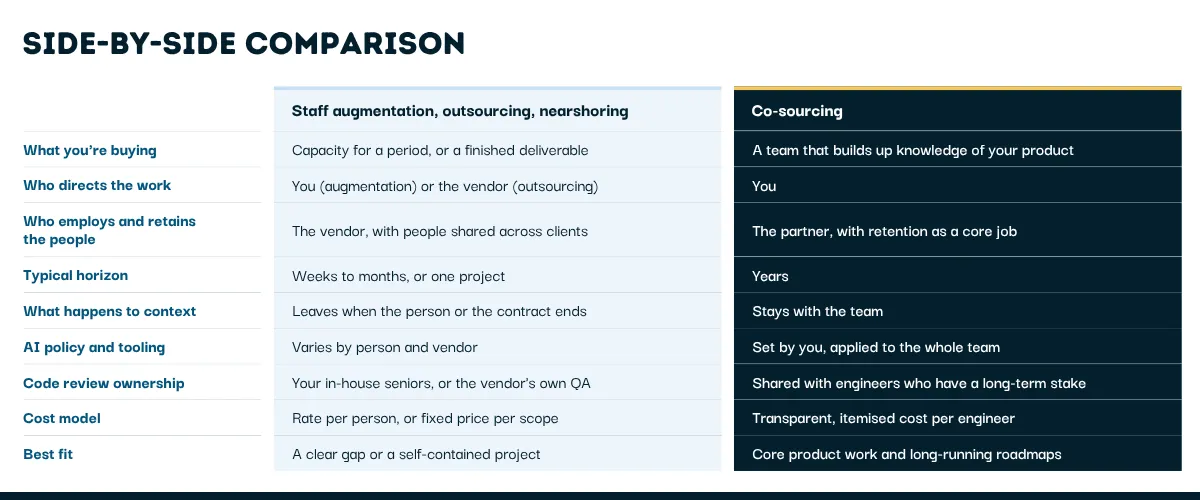
Co-sourcing vs staff augmentation vs outsourcing: a side-by-side comparison
 How do you choose between co-sourcing and staff augmentation?
If you are unsure, answer three questions honestly.
- Will this work still exist in 18 months? If yes, you want the knowledge to stay.
- Will AI write a large share of the code? If yes, review and context matter more than raw capacity.
- Does someone need to own quality after launch? If yes, look for people who expect to be around for it.
Three yeses point to co-sourcing. Three noes point to augmentation or outsourcing. A mix usually means you need both: a stable core team, with short-term specialists brought in around it. It's a setup we see often, and it is why we run Mission Pods for peaks alongside dedicated co-sourced teams.
What should you ask an outsourcing or staff augmentation provider?
The labels don't help much. Some providers call long-term dedicated teams "staff augmentation". Others call short contracts "dedicated". Nearly everyone claims the top 1% of talent. So ignore the name on the proposal and ask these questions instead.
- Do the engineers work only for us? If they split time across clients, your context is competing with someone else's.
- What was your engineer attrition last year, and how do you count it? A number without a definition tells you very little.
- Who is responsible for keeping people, and what do they do about it? "We'll replace them quickly" is an answer about churn, not retention.
- What happens to knowledge when someone leaves? Ask for the handover process, not the promise.
- Whose AI policy do the engineers follow? It should be yours, and someone on their side should enforce it.
- Can we see the cost breakdown? Salary, benefits, office, management fee. If you can't see it, you can't judge it.
The answers will tell you which model you are buying far more reliably than the brochure.
How has AI changed what companies expect from engineers?
Since 2018, we have operated co-sourced teams based in Sofia. Currently, there are over 70 engineers spread across more than 15 teams, and 85% of our partners have remained with us for more than four years. These figures are more significant in the AI era than they were previously, due to the reasons mentioned. This is the perspective from two seats within the organisation.
From the client side
Our CEO pushes back on the idea that what clients want has changed at all. In his view, the bar stayed where it was. What moved is the definition of clearing it.
"I don't think anything has really changed. Our clients have always wanted high-quality software engineering talent. It's just that what that looks like is different now, because the skillset is different. They still want the best engineers we can provide, but the focus is more on product development than on being a front-ender or a back-ender. The basics of software engineering aren't less important. AI has raised expectations of what engineers should be able to do with those skills."
Benjamin Kane, CEO, TechPods
From the engineering side
What breaks first when a team without codebase context goes heavy on AI:
“AI made writing code cheap. It didn’t make knowing whether that code is right cheap. Today, the most expensive mistake is writing perfect code for the wrong problem.
That’s because a lot of the knowledge isn’t in the repo. Business logic is usually worked out in team discussions and often never gets written down anywhere an LLM can reach. Even when it is written down, the LLM still doesn’t know why a check exists, or what broke last March and why.
So when a team without that context goes heavy on AI, the first thing that breaks isn’t the code. It’s the product. That can stay hidden until it’s too late, because everything looks fine. PRs get approved, builds pass, tests pass. The tests pass because the same AI wrote them, with the same wrong assumption. Everything seems to be heading in the right direction, until it isn’t. Velocity looks great right up to the incident.
An engineer who’s been on the system for two years tells the AI what it can’t see, and reviews for what the diff doesn’t show.”
Mike Panayotov, CTO, TechPods
Is co-sourcing the right model for your team in 2026?
For the majority of product teams, indeed. AI plays a significant role in this.
AI has reduced the cost of writing code while increasing the difficulty of trusting it. The focus has shifted from hours and headcount to three aspects: understanding the system, taking responsibility for code review, and remaining long enough for both to yield benefits. Short engagements struggle to give you any of them. A co-sourced team is built around all three.
Staff augmentation and outsourcing still have their place. For a clear gap with an end date, or a project you can spec and forget, they do the job. For those cases, alongside co-sourcing, we also run Mission Pods: one engineer or a small team, brought in for a shorter stretch around your core team without disrupting it. But for the product you'll still be running in two years, renting capacity means paying again and again for context you never get to keep.
That is the framework we have developed TechPods around since 2018. Our teams in Sofia exclusively collaborate with one partner, adhere to that partner's standups, backlog and AI policy, and often remain for years: 85% of our partners have been with us for over four. We manage hiring, HR, payroll, and retention, with all expenses transparent, allowing your engineering leaders to concentrate on the product.
If you're weighing your options, talk to us. We'll show you what a dedicated team in Sofia could look like for your product, and we'll tell you honestly if a short-term fix is the better call.
Frequently asked questions
Is co-sourcing the same as outsourcing?
No. With outsourcing, you hand a scope to a vendor, and they deliver it with their own people and process. With co-sourcing, you get a dedicated team that works only for you and that you lead directly, while the partner handles local employment, HR and retention.
Is staff augmentation still worth it in 2026?
Yes, for the right job. It works well for a clear skills gap with an end date, such as a migration or a launch peak. For core product work that will run for years, the context a long-term team builds up is worth more, especially now that AI writes a large share of the code.
Is nearshoring the same as co-sourcing?
Not quite. Nearshoring describes where the engineers are, in a time zone close to yours. Co-sourcing describes how the team works: dedicated, long-term and led by you. A co-sourced team can be nearshore, as ours in Sofia is for UK companies, but a nearshore vendor isn't automatically co-sourcing.